
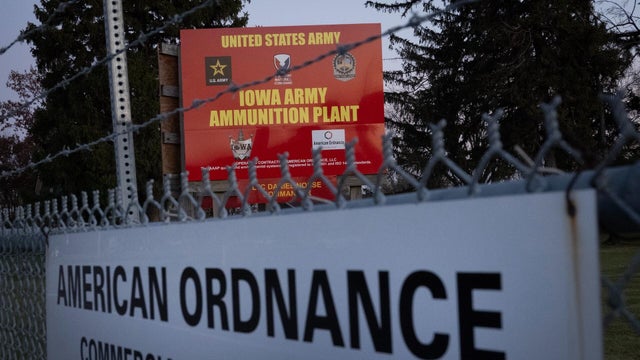
A federal judge halted the U.S. Army’s plan to blow up several tons of unstable explosives at the Iowa Army Ammunition Plant after residents voiced concerns that a dust cloud could carry toxic lead particles into parts of Iowa and Illinois. The 8th U.S. Circuit Court of Appeals granted an emergency motion filed by environmental groups, putting a pause on the demolition of lead azide.
The explosions had been slated for Friday at noon in Middletown, a rural town of about 360 people roughly four hours from Chicago. After the Army pushed the date back to the following Monday, the court intervened.
In a statement, the Army said it was coordinating with the Department of Health and Human Services and the Environmental Protection Agency to carry out the blast in the safest possible way. “We have been meticulously planning this event since March, and all involved agencies are ready to employ the most stringent mitigation measures to protect the public and limit any disruption,” the statement read.
The Army’s justification for the detonation stems from a discovery made in March that 68 drums of lead azide stored in underground bunkers were undergoing recrystallization. Lead azide is a primary explosive that can be set off by the slightest spark, flame, friction or even a pinprick. The EPA has warned that recrystallization raises the chance of a spontaneous explosion, creating a highly unstable situation. Cold weather, according to Justine Barati, a public‑affairs specialist with the Army Sustainment Command, would further increase the likelihood of an accidental detonation.
Officials said moving the material was not a safe option. After modeling four possible neutralization methods, the Army concluded that a controlled blast presented the lowest risk to nearby communities. “Our analysis showed that a controlled detonation was the option that posed the least danger to the public in the immediate and surrounding area,” Acting Secretary of the Army Adam Telle said.
The Army reported that it had reached out to stakeholders and residents in Middletown and the surrounding region about the approved plan, but critics argue they were only informed days before the scheduled explosion. Local elected officials blamed a lack of communication for the anger and confusion among residents. Iowa’s governor‑elect, Rob Sand, said, “The safety of Iowans now and in the future should be the government’s top concern. An unacceptable lack of communication and clarity has made Iowans understandably concerned and angry about this situation.”
The chief health worry is that lead particles could be dispersed in the plume generated by the blast. Lead is hazardous at any concentration, especially for children. “Lead is a really challenging contaminant,” said David Cwiertny, a professor at the University of Iowa and director of its Environmental Policy Research Program. He explained that lead could become airborne or settle on the ground, noting, “We do expect that air to dissipate fairly quickly as it moves with the wind.” According to the National Institutes of Health, lead exposure—through food, water, dust or fumes—can impair growth, cause learning disabilities and damage the nervous system, with children under six being the most vulnerable, per the CDC.
Residents were instructed to leave the immediate vicinity before the blast, but many fear that the fallout could contaminate soil and groundwater for years. Sean Byers, who lives across the street from the plant and has three young children, pointed to a nearby playground and said, “There’s a playground back over there where kids in the community play all the time. It’s going to linger probably for decades. It’s going to affect everyone.” Byers said he learned of the explosion from a neighbor only a few days before it was to occur and plans to evacuate his family to Branson, Missouri, for three or four days. He was told the Army expects residents to be able to return after six hours, a timeline he “highly doubts.”
The Army’s mitigation plan calls for detonating the drums inside concrete magazines that will be covered with earth and surrounded by two‑story‑high Hesco sand barriers. Soil above the magazines would be saturated with water before and during the blast, and water misters would be used to suppress dust. Residents would be asked to vacate while the explosion creates temporary noise, ground vibration and a dust plume containing some lead.
Byers received a notice that windows might break during the blast and that the plant would replace any that do. He responded, “The damage at that point has already been done, because it’s going to let all that lead enter the house. And the question is, are they going to come in and decontaminate that? Are they going to, you know, are they going to do that? Probably not.”
The Army maintains that, thanks to its mitigation measures, any lead particles released into the air after the detonation will remain well below the thresholds that would trigger EPA protective actions.