
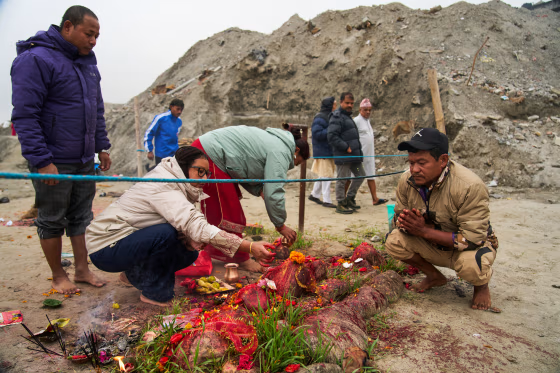
NUWAKOT, Nepal — In the shadow of a temple that once drew generations of worshippers, villagers now stand amid a mound of earth where the shrine once rose, uncertain whether it will ever be rebuilt. Farmers who previously cultivated rice to sustain their families are now huddled in temporary metal shelters, wondering if they will ever regain ownership of their fields.
The August floods that swept through Nuwakot and neighboring districts erased entire villages, killed or left missing thousands, and have left daily life in a standstill. Along the Trishuli River, power lines, solar panels, cars and homes lie half‑buried in mud, while collapsed bridges have isolated communities from nearby towns. Survivors sleep in makeshift shelters, depending on aid for drinking water and food while they wait to learn when and how they can begin to rebuild.
“Only God knows how long we will have to stay here,” said 45‑year‑old Lakchin Bahadhur Tamang, a worker at a hydropower plant, to the Associated Press on a recent morning. “I’m afraid that when the aid agencies and volunteers finally leave, we will be left without even enough water to drink.”
Thousands of kilometres away, at the United Nations climate summit in Turkey – COP31 – Nepalese officials and other representatives from mountain nations are urging the world to act now, warning that rising temperatures will bring more frequent and severe disasters, including the disintegration of Himalayan glaciers. Their message centers on a fund created three years ago to compensate developing countries hit by climate‑related catastrophes. Experts say the pool of money is far too small and tangled in bureaucracy, and that larger, faster disbursements are essential if recovery is to keep pace with the accelerating frequency of climate shocks.
Nepal and its fellow mountain states are pressing negotiators to keep the risks facing their high‑altitude communities on the agenda. Although Nepal and Bhutan tried to secure a dedicated negotiating item on warming in mountain regions at the start of the summit, the proposal was not adopted. Foreign Minister Shisir Khanal told delegates that Nepal wants a specific programme on mountains and climate change so that the unique vulnerabilities of these regions are reflected in international climate policy and financing decisions.
“After the disaster we received an outpouring of sympathy. Now is the moment to turn that sympathy into concrete support,” Khanal said at the talks last week.
The implications extend far beyond remote villages. Glaciers and snowfields in the Hindu Kush‑Himalaya basin feed rivers that supply drinking water, irrigation and electricity to nearly two billion people, according to the Kathmandu‑based International Centre for Integrated Mountain Development (ICIMOD). As temperatures rise, glaciers retreat and permafrost thaws, destabilising slopes. Floods laden with rock, ice and debris can surge across borders in minutes, leaving downstream populations with little warning, especially as early‑warning systems suffer from funding cuts.
Global average temperatures are projected to exceed the 1.5 °C (2.7 °F) warming limit set in the 2015 Paris Agreement within the next few years. While much of the debate focuses on how to pull the world back under that threshold – a task that would require unprecedented cuts in greenhouse‑gas emissions – scientists caution that the loss of snow and ice cannot be easily reversed. Pam Pearson, director of the International Cryosphere Climate Initiative, warned that “there is no negotiating with the melting point of ice,” noting that ice can disappear quickly while its recovery may take centuries or millennia.
At COP31, climate experts stressed the need for real‑time cross‑border monitoring of unstable slopes and glacial lakes, coordinated early‑warning systems and reliable global financing. “Every time there’s a disaster in the Himalayas, we treat it as a wake‑up call,” said Pema Gyamtsho, director‑general of ICIMOD. “The question is: what will it take for us to truly wake up and act?”
The United Nations Fund for Responding to Loss and Damage, established in 2022, was designed to channel financial assistance to vulnerable developing nations suffering climate‑related losses. Its creation followed protracted negotiations over how much wealthier countries – including the United States, the world’s top historical emitter – should contribute to help poorer nations adapt to a crisis they did not cause.
Protesters at COP31 have repeatedly chanted “climate justice now,” demanding help for Nepal. Yet the fund’s contributions have fallen far short of expectations. For Nepal, the fund has pledged roughly $20 million – a tiny slice of the roughly $2.5 billion the country estimates it has lost. Khanal has said that rebuilding could cost about ten percent of Nepal’s gross domestic product.
Manjeet Dhakal, a member of Nepal’s delegation and chief adviser to the least‑developed‑countries group at the summit, welcomed the initial pledge but stressed that “the scale of the resources needs to increase.” To date, donor nations have pledged just over $820 million to the fund, while 176 developing‑country requests total about $2.8 billion. The fund’s board is scheduled to meet in December to consider additional support.
The Stockholm Environment Institute projects that by 2030 the annual financing needed for loss and damage in low‑income countries could range from $400 billion to $1.6 trillion. So far, the fund has been slow to translate pledges into payouts. Money earmarked for Nepal remains tied to a formal funding proposal and pending board approval, with no concrete disbursement date announced.
For those still living among the ruins, the gap between what has been offered and what is required feels insurmountable. Standing amid collapsed structures, 41‑year‑old Dhurba Bhandari, who runs a small shop, pointed out that Nepal contributed little to global carbon emissions yet bears the brunt of the disaster.
“The international community must accept responsibility and help those displaced, as well as support reconstruction,” he said.