
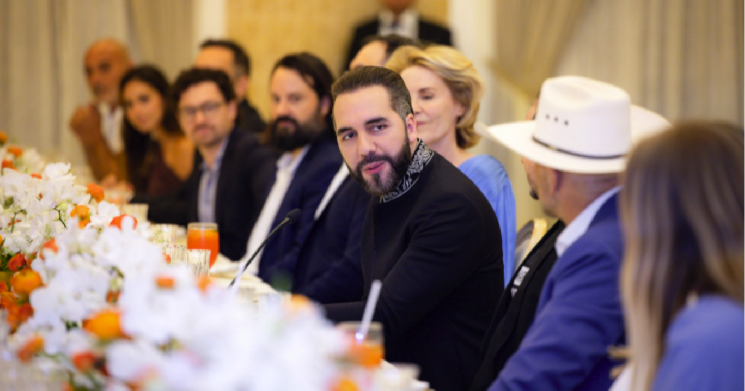
On the evening of 10 November, while the Bitcoin Histórico summit was under way in San Salvador’s historic centre, a small group of Bitcoin‑industry figures gathered for a private dinner with President Nayib Bukele. The event, arranged by the Bitcoin Office – a unit within the presidential administration – was overseen by Stacy Herbert and Max Keiser. It ran from roughly 7:30 p.m. to 10:30 p.m. local time and brought together about thirty participants, many of whom are regular visitors to the country.
Among those at the table was billionaire Ricardo Salinas Pliego, the founder of Grupo Salinas and owner of Banco Azteca. Salinas, a vocal supporter of Bitcoin who has previously appeared with Keiser and Herbert, also met the president privately before the meal and presented him with the first two volumes of “Manuscripts of the Conquistadors,” a collection edited by Grupo Salinas chief of staff Jorge Nikaido.
The guest list spanned investors, founders, miners, technologists and media personalities. Representing capital and start‑ups were Parker Lewis of Unchained Capital, Bitcoin‑Beach pioneer Mike Peterson, Citizen X’s Katie Ananina and Satlantis founder Aleks Svetski. Mining executives included Beau Turner of Abundant Mines, Nacho Pauls, chief commercial officer of OCEAN Mining, and Adam Ortolf of Denver Bitcoin Mining. Also present were Bitcoin‑core contributor Jon Atack, Plan B Network engineer Giacomo Zucco, AI entrepreneurs Ginger Gaetz (ANIA AI) and Marc Seal (Aevonix), as well as academic‑media figures Michael Goldstein – known as Bitstein and co‑founder of the Nakamoto Institute – economist Eric Yakes, author of *The 7th Property*, and independent journalist‑podcaster Efrat Feningson. Local Bitcoin advocate Michael Ruiz, founder of Build in El Salvador (BIS), also attended.
Guests arrived early and used the waiting time to mingle. Keiser made a theatrical entrance carrying a case that, according to photographs, held a Stetson “El Presidente” cowboy hat; some observers have whimsically suggested it might have concealed the philosopher’s stone. Bukele greeted each participant, ushered them to their assigned seats and signalled that the evening would be informal – no speeches, just conversation, Ananina told Bitcoin Magazine, likening it to an open‑mic session.
Herbert noted that the president’s table was decorated with orange‑hued flowers reminiscent of Bitcoin’s branding, and that the gathering brought together a mix of self‑described anarchists, billionaire entrepreneurs, Wall‑Street financiers, circular‑economy activists, venture‑capital investors, miners and content creators inside the nation’s equivalent of the White House. A three‑course menu was served, featuring steak as the main entrée and a three‑layer chocolate dessert to finish. Over the course of about three hours, six or seven substantive questions were posed, with Bukele speaking through a microphone that was occasionally passed around.
When the conversation turned to power generation, Salinas led the discussion. Turner recalled Bukele explaining that the country’s current electricity output roughly matches its present demand, but that plans are under way to add more than a gigawatt of new capacity through projects such as geothermal plants and imported liquefied natural gas. Turner highlighted that the president explicitly linked these supply expansions to the need for compute power, whether for Bitcoin mining or other data‑center operations, and that the anticipated demand could come from government initiatives or foreign investors setting up equipment in El Salvador. Salinas, whose Grupo Dragón holds stakes in geothermal, wind, solar and natural‑gas facilities across Mexico, expressed enthusiasm for the approach.
Immigration surfaced after Keiser’s impassioned remarks that the world should take note of El Salvador’s trajectory and consider moving there. Ruiz, a U.S.‑born Salvadoran who relocated three years ago and now plays a visible role in the local Bitcoin scene, asked about possible gentrification and resentment toward Western newcomers, citing online accusations that Bitcoiners are “colonizers.” Bukele responded by asking what everyday interactions with Salvadorans are like; Ruiz answered that locals are warm and welcoming. The president then joked that, if the nation matched Manhattan’s population density, it could theoretically accommodate the entire world’s population – a hyperbolic comment meant to put the issue in perspective rather than set a policy goal. He added that El Salvador seeks the most capable and intelligent people, noting that historic empires have always relied on immigrants.
To address concerns about rising wages and social tension, Bukele recounted a story of a fisherman and a house‑caretaker whose monthly earnings jumped from $300 to $800 after an American bought the property they worked on. The extra income allowed the fisherman to purchase a motor for his boat, expanding his catch and enabling the caretaker’s son to acquire his own vessel, effectively doubling the family’s fishing fleet. According to the anecdote, only the neighbours complained, feeling the pressure of the newfound prosperity.
When journalist Feningson asked why Bukele faces criticism abroad despite domestic economic gains and a noticeable drop in gang violence, the president replied that he does not belong to the “club” that shapes the dominant narrative. He suggested that mainstream media, influenced by central banks such as the European Central Bank, spreads negative portrayals, and that many officials are simply “order followers” who cling to established storylines and resist novel paradigms.
Education reforms also entered the dialogue. Bukele mentioned that a growing number of private schools are adopting AI‑driven tutoring tools similar to those piloted by his administration in public schools, a program that has recently lifted PISA scores to levels comparable with Germany and Switzerland.
Reflecting on the conference, Keiser described Bitcoin Histórico as delivering “Excellence Only,” praising the National Palace’s regal ambience as a fitting backdrop for what he called a “Renaissance 2.0” unfolding in El Salvador. He said attendees felt transported to a unique moment of optimism and abundance, free of the usual doom narratives.
Herbert, who oversaw many of the event’s details, told Bitcoin Magazine that the organizers aimed to blend “Philosopher‑King” sensibilities with a Renaissance‑style vibe, and that guests were encouraged to raise any question without restriction. She added that the president’s unscripted wit and intelligence were on full display, leaving participants with a clearer sense of why they believe the country is thriving under his leadership.
The piece originally appeared in Bitcoin Magazine and was written by Juan Galt.
Source: CryptoNews.net