
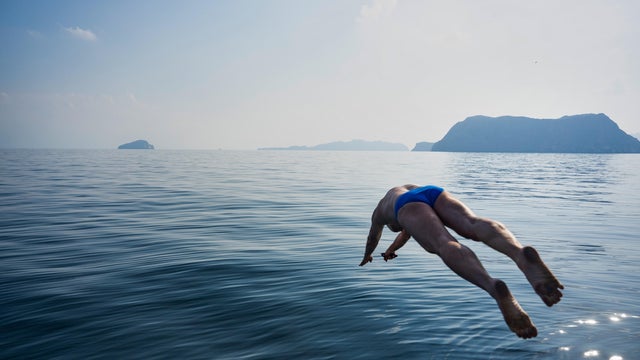
British endurance swimmer Lewis Pugh, known for his polar swims that spotlight environmental issues, has taken on a new and perilous mission: crossing the Strait of Hormuz while nearby tankers are being struck and blown up.
Pugh, a United Nations Patron of the Oceans, spent three days this week navigating sections of the volatile waterway to draw attention to the damage the conflict with Iran is doing to the region’s ecosystems. Dressed only in swim trunks, goggles and a cap emblazoned with the UN emblem, he launched from the Musandam Peninsula at the southern end of the strait and finished by rounding the Cape of Hormuz, covering roughly 9.3 miles in total. He is believed to be the first person to attempt a long‑distance swim there since the war began.
“Within minutes of getting into the water on Monday I heard two massive blasts that shook the sea,” Pugh told the Associated Press after returning to London. “I looked up and saw an oil tanker about four kilometres away had been hit. The noise was deafening—two booms followed by fighter jets arriving. In that instant I knew we had to get out immediately.”
The 56‑year‑old completed the swim despite several interruptions, including passing a vessel that erupted in fireballs after being attacked.
“Most people picture the Strait of Hormuz simply as a shipping lane,” he said. “For me it’s also one of the most stunning places on the planet—a real treasure trove of wildlife.”
He warned that the constant sinking of ships is putting the area under extreme stress and that recovery could take years, if not decades.
In recent weeks Iran has stepped up assaults on vessels it says are using unauthorized routes, seeking tighter control over the strategic channel through which roughly one‑fifth of the world’s oil passed before the United States and Israel launched their war on 28 February. Several tankers have also struck mines laid by Tehran, some exploding and igniting, including a vessel that was carrying more than two million barrels of oil last month.
Pugh cautioned that oil spills from the dozens of damaged tankers since February could have long‑lasting effects on marine life, coastlines, coral reefs and mangrove forests. He recounted seeing large pods of dolphins trailing his support boat, as well as turtles and ospreys, and recalled the hundreds of turtles he observed along the Omani shore before hostilities began.
“When oil or chemical pollutants enter the water, the cleanup becomes almost impossible and the damage can persist for generations,” he said.
Having faced extreme cold and predators such as great‑white sharks in previous swims, Pugh said the dangers of a war zone were a different kind of threat. To mitigate risk, the challenge was broken into segments over three days, amounting to about six and a half hours of swimming in total. On the second day, as he headed back to harbor, he passed a gas carrier that had been hit.
“I’ll never forget the sight of that gas carrier—its smell, the flames shooting up like fireballs, the water itself seemed to be on fire,” he recalled. “The immediate impact on the surrounding nature was stark and heartbreaking.”
Over the past four decades Pugh has swum in locations ranging from Antarctica to the Red Sea and the English Channel, using his feats to call for stronger action against climate change, pollution and biodiversity loss. He was the first athlete to cross the North Pole on foot and to complete a long‑distance swim in every ocean, and in 2023 he traversed the full 315 miles of the Hudson River to highlight the need for clean waterways.
His foundation says his campaigns have helped secure formal protections for more than 1.35 million square miles of vulnerable ocean. Some observers have dubbed his blend of extreme swimming and advocacy “Speedo diplomacy.”
“Sport opens doors, sparks conversation and gets people thinking about critical issues,” Pugh said. “My message is simple: end the war, reopen the strait and clean up the pollution.”