
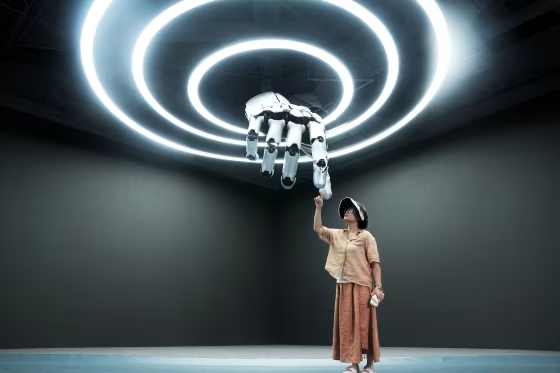
LONDON — Concern over the rise of artificial intelligence prompted the Cambridge Dictionary to look back to the 15th century for a term that it believes best encapsulates the mood of 2026.
The dictionary has selected “human” as its word of the year, a choice that serves both as a nod to history and a subtle rebuke to the way AI is blurring the distinction between machines and people.
“AI is reshaping the way we talk about what it means to be human,” explained Colin McIntosh, a lexicographer at Cambridge. “Anxieties about what we might lose when we hand over thinking tasks to machines have forced us to re‑evaluate how dependent we are on AI, from elite mathematicians to elementary‑school teachers.”
Derived from the Latin *humanus* and in documented use since the 1450s, Cambridge defines the adjective as “possessing the qualities, flaws and emotions that characterize people, as opposed to gods, animals or machines.”
When choosing a word of the year, dictionaries usually pick a newly coined term—often slang that has entered mainstream usage—or an established word that has acquired a fresh significance.
Artificial intelligence has featured prominently in recent word‑of‑the‑year selections across several reference works. Collins Dictionary named “AI” its 2023 choice, the same year Cambridge highlighted “hallucinate” to describe the tendency of AI systems to generate false information. Merriam‑Webster’s 2024 pick was “slop,” referring to low‑quality content produced by AI, while Collins later opted for “vibe coding,” a term for an AI‑assisted approach to software development.
“AI is making us think harder about what it means to be human,” said Bill Gates, Microsoft co‑founder and advocate for responsible AI use, in response to Cambridge’s announcement. “We should judge AI’s success by how much it enhances human lives.”
Other candidates considered for the 2026 title included “agent,” referring to an autonomous AI system capable of making decisions without human oversight, and “analogue,” denoting experiences or objects that exist outside the digital or internet realm.