
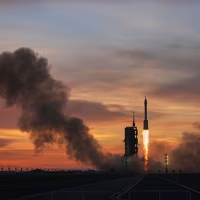
China launched the Shenzhou 24 spacecraft on Wednesday, carrying a crew of three – two Chinese astronauts and a Pakistani astronaut – marking the first time a foreign crew member has flown to China’s Tiangong space station.
The mission’s three‑person crew consisted of Pakistan’s Muhammad Zeeshan Ali, 40, who became the first non‑Chinese astronaut to board the station, alongside Chinese pilots Tang Hongbo, 51, and Wu Yi, 39. The launch took place from the Jiuquan Satellite Launch Center in northwestern China, after which the spacecraft detached from its carrier rocket and entered its planned orbit before rendezvousing with the station. Once docked, the three joined three astronauts from the earlier Shenzhou 23 flight for a group photograph.
The flight represents the inaugural joint Chinese‑foreign crewed mission in the history of China’s human‑space program. Earlier that day, crowds gathered for a send‑off ceremony, many recording the event on their phones. In Pakistan, crowds shouted “God is great!” and “Long live Pakistan‑China friendship!” as the rocket lifted off, while families far from the launch site watched the event on television. Restaurants and public venues displayed the live feed, and scientists at Pakistan’s space agency headquarters followed the launch closely.
President Asif Ali Zardari of Pakistan and President Xi Jinping of China exchanged congratulatory letters, each praising the inclusion of a Pakistani astronaut as a milestone in bilateral relations, according to a statement from Zardari’s office. Chinese state television CCTV reported that Xi described the Tiangong station as a “boat” for peace, friendship and cooperation, emphasizing China’s willingness to promote the peaceful use of outer space and deepen international collaboration.
Prime Minister Shehbaz Sharif hailed the mission as a source of national pride and an inspiration for Pakistani youth, writing on X that the flight “is not just one astronaut’s journey, but the journey of 240 million Pakistanis.” He thanked China for the opportunity, noting that the partnership now extends into space. Planning Minister Ahsan Iqbal told reporters that the launch could be the start of broader future cooperation, expressing gratitude to President Xi, Chinese leaders, and the scientists and engineers involved. When asked whether Pakistan might eventually launch its own astronauts, he replied, “Certainly that day will come.” Iqbal added that Ali carried not only his own name but also the Pakistani flag, embodying the hopes and technological aspirations of his country. “The sky is no longer our limit; it is our launching pad,” he said, urging young Pakistanis to pursue science and technology careers.
The joint mission stems from an agreement signed by China and Pakistan in February 2025. According to Xinhua News Agency, the crew will carry out more than 90 scientific experiments and technology demonstrations. Ali is slated to conduct a photosynthetic cyanobacteria experiment during his short‑duration stay, after which he will return to Earth aboard the Shenzhou 23 vehicle. This flight is the first for both Ali and Wu Yi, while Tang Hongbo, who has previously flown twice, becomes the first astronaut to visit the Tiangong station three times, CCTV reported.
At a press briefing on Tuesday, Tang noted that language, cultural and psychological differences made teamwork more demanding on this mission, but that joint efforts were bearing fruit. He highlighted Ali’s proficiency in Mandarin, noting that the Pakistani astronaut recited a line of Chinese poetry about climbing a story higher to see farther, saying, “It’s like my daily training—day after day, reaching new heights.” Speaking in English, Ali expressed hope that future cooperation would expand from a single astronaut on a single flight to multiple joint missions and eventually to lunar, Martian and deeper space endeavors.
China is targeting its first crewed lunar landing by 2030, while the United States, viewed as China’s principal space competitor, aims to return astronauts to the Moon by 2028 under NASA’s Artemis program.