
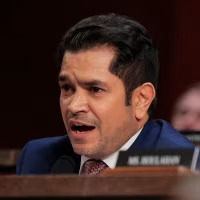
Democratic Representative Jimmy Gomez of California announced on Monday that he will step down next week after the House Ethics Committee concluded that he had engaged in sexual misconduct with a congressional staff member, a finding that could amount to a misdemeanor sexual abuse charge.
In a statement, Gomez said, “I understand the gravity of the Ethics Committee’s findings, and as I have already said, I accept full responsibility for the personal errors I made outside my marriage.” He added that he had cooperated with the investigation but expressed “strong disagreements” with the committee’s report and its conclusions.
“The report omits significant portions of my testimony that are crucial for a complete and fair picture of what happened,” Gomez wrote. “I also have serious concerns about the investigative process. In my interview I answered the Committee’s questions, yet my statements were selectively quoted, mischaracterized and ignored in the final document, and I was not given a chance to respond.” Because of those concerns, he said, “the only option left is to resign, effective Dec. 1, so my staff can finish essential constituent work.”
The resignation will accelerate his exit from Congress by roughly a month. Earlier this month, Gomez lost his primary in the 34th District to Democratic socialist Angela Gonzales‑Torres, a race that unfolded while the ethics probe was ongoing.
The case follows the recent fallout for Gomez’s close ally, former Representative Eric Swalwell, who withdrew from the California governor’s race and resigned from Congress after multiple women, including a House staffer, accused him of sexual assault.
The Ethics Committee opened its inquiry into Gomez after reports linked him to a party where he was seen kissing a staff member. Gomez told investigators he had interacted with two women, describing the contact as consensual kissing. One of those women, identified in the report as “Witness 1,” described the encounters as unwanted sexual advances. Witness 1, in her mid‑20s, worked for a House leadership office—not for Gomez—and left her staff position in 2025.
According to the committee’s findings, the first incident occurred in 2024 while celebrating an unnamed member of Congress’s birthday at the Rocket Bar in Washington, D.C. Witness 1 said Gomez groped her and forced her against a wall before kissing her outside the venue. Gomez acknowledged that he kissed her and that there was sexual contact, but maintained that she had consented. He later told investigators that another person had relayed her account to him.
The second alleged incident took place in Gomez’s congressional office after late‑night votes. Witness 1 said Gomez attempted to kiss her and acted forcefully, describing the behavior as non‑consensual. Gomez denied that she was uncomfortable and said he never tried to prevent her from leaving.
The Ethics panel did not recommend formal disciplinary action such as censure or expulsion, likely because Gomez was already set to leave office in January. Instead, the committee issued its report as a warning to the entire House, emphasizing a “zero‑tolerance” stance toward unwanted sexual advances toward staff.
“The Committee’s role is to investigate alleged misconduct and, when appropriate, hold members accountable for behavior that reflects poorly on the House or endangers other members and staff,” the report read. “Having determined that Representative Gomez made unwanted sexual advances toward a House staffer, we adopt this report to hold him accountable and to signal to the whole House that such conduct will not be tolerated.”
House Democratic leaders Hakeem Jeffries, Katherine Clark and Pete Aguilar responded with a joint statement: “The allegations of wrongdoing and abuse of power by Rep. Gomez are serious and deeply troubling. His decision to step down is appropriate. Prompt action to establish a new standard for reform is an urgent priority for House Democrats.”
The release of the Gomez report coincides with the Ethics Committee’s recent adoption of six procedural reforms aimed at accelerating investigations and increasing transparency, especially in sexual‑misconduct cases. A source told NBC News that the changes were approved without amendment after an uncommon public meeting.
The new rules require the public disclosure of substantiated sexual‑misconduct findings while safeguarding victims’ identities, allow the committee chair and ranking member to issue subpoenas jointly without a full committee vote, and streamline disciplinary processes.
These reforms come amid longstanding criticism of the slow and secretive nature of congressional misconduct investigations, including instances where lawmakers resign before inquiries conclude. They also align with a broader bipartisan effort to overhaul workplace standards in Congress announced earlier this year.
Mark DeSaulnier, the senior Democratic member of the Ethics Committee, said the updates resulted from bipartisan discussions and collaboration with the Congressional Women’s Caucus. “The House must enforce a zero‑tolerance policy for sexual harassment and misconduct, and the Ethics Committee is committed to ensuring its procedures hold perpetrators accountable and deliver justice for survivors,” he said.