
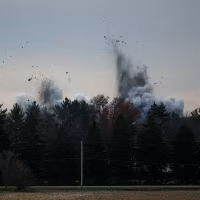
Questions linger about lead pollution from Iowa blast, despite officials’ assurances
Federal officials reassured the public on Wednesday that the Army’s detonation of a lead‑azide cache in Iowa generated only a minimal plume of lead dust. Independent scientists and nearby residents, however, said they still have unanswered questions about the extent of contamination and its precise locations, even as they welcomed the early data.
People who lived closest to the explosion site and obeyed evacuation orders said they remain uncertain about when it will be safe to go back home. In a post on X at about 5:30 p.m. local time, the Army announced that FEMA had issued an “all clear” for the Iowa Army Ammunition Plant, where the blast took place, but offered few specifics. “Post‑detonation surface sampling is under way, and we will release the findings when they are complete,” the statement read.
Sean Byers, whose house sits across the street from the plant, said he intends to keep his family away for several days. “Even though the Army says they haven’t found lead in the air, I suspect they have a reason to make that claim,” he said. “I think many people are downplaying any long‑term risks because they imagine the plume to be less dramatic than feared.”
The Environmental Protection Agency reported that its real‑time air monitors at four locations detected no lead in the atmosphere after the blast. Outside experts cautioned that it could take several days to identify any hotspots that might need remediation.
A number of specialists expressed cautious optimism that the Army avoided the worst‑case scenario in Middletown, Iowa. The explosion, which occurred at 9 a.m. local time, had sparked intense public opposition over the previous two weeks. Residents complained that the Army’s communication was poor and that the timing—just before Thanksgiving—gave them insufficient time to prepare, prompting officials to postpone the detonation. Army officials have said that destroying the 9,700 pounds of lead azide was the only viable option because the material had degraded to the point where it could detonate spontaneously.
Lead is a potent neurotoxin, and no exposure level is considered safe. To determine how far any lead dust may have traveled and how much contamination might exist, scientists from universities and the EPA have been deployed across Iowa to collect and analyze samples.
Dr. Joel Kaufman, a professor of medicine, epidemiology and environmental health sciences at the University of Washington who studies air pollution, called the EPA’s initial real‑time monitoring a promising sign but stressed that laboratory analysis of ground‑collected dust is essential. “Real‑time monitoring is a reasonable first step, but we need to test samples from many locations,” he said. “It’s possible the amount of lead released is essentially zero, but we have reason to be cautious.”
Andrew Whelton, a professor of civil, environmental and ecological engineering at Purdue University, agreed that physical sampling is crucial. “You have to gather deposited particles and send them to a lab for chemical analysis,” he said.
The EPA said on Wednesday that about 300 employees and contractors were on the ground in Iowa and that they had collected roughly 1,200 air, soil and water samples before the detonation. “We are working diligently to ship the new post‑event samples to EPA laboratories immediately,” the agency posted on X.
Garrett Anthony, a resident of Burlington about seven miles from the blast site, said he evacuated earlier in the week. “I’m relieved the live EPA monitoring shows zero lead in the air, but the ground testing is still extremely important to me, and I want to see what comes next,” he said. “I’m also keeping some of my own soil as a baseline in case we need to compare later.”
In a letter to Iowa’s governor on Friday, Jim Macy, the EPA’s regional administrator, noted that the Army’s permit required a plume estimate to be updated and distributed within six hours of the explosion. The Army released deposition and air‑dispersion maps at 3 p.m. local time, but the documents offered few immediate details; the air‑dispersion map showed no plume because sensors did not detect lead. One of the maps simply read, “Post‑detonation sampling underway. Results will be published when available.”
Macy said the EPA expects to receive initial results from dust‑wipe samples in the days following the blast, but a comprehensive review will take longer. Both the Army and the EPA are also tasked with identifying any water bodies that might have been affected and with promptly contacting public water systems to provide lead‑testing kits, drinking‑water assessments and filtration equipment for households.
In the weeks leading up to the detonation, Whelton had criticized both agencies for not making their testing plans public. He pointed to the Army’s permit filings, saying they lacked an evidence‑based strategy for determining whether homes, schools and businesses were safe.
Academic researchers had been preparing for more than a week to conduct their own air and soil sampling. Patrick O’Shaughnessy, a professor of occupational and environmental health at the University of Iowa, said he planned to draw air through a specialized pump and filter to capture dust particles. “Then the filter has to be sent to a lab with sophisticated equipment to determine the lead content,” he explained on Friday. Other University of Iowa teams intended to use wipe samples on surfaces for analysis. “We’ll collect as many as we can,” O’Shaughnessy added, noting that colleagues from Oregon and New York had flown in to assist. The group hoped to have some preliminary findings ready by Thursday morning.
Anthony said he wants an independent review by outside scientists to confirm the Army and EPA data. “It would be reassuring to hear multiple sources agree,” he said, acknowledging that such verification will take time.
At the blast site, the Army and its contractors anticipate a three‑month cleanup and remediation effort. Permit documents projected a crater roughly 38 feet wide and five feet deep, with large concrete fragments potentially traveling up to half a mile. Workers, equipped with full‑body Tyvek suits and respirators, may need to move as much as 13 tons of debris to a hazardous‑waste facility.
Public outcry over the detonation plan led the Army to add last‑minute protective measures not listed in the original permit, including gel blocks, aqueous foam and a wall of water containers designed to absorb debris and limit spread of contamination. It remains unclear whether these added safeguards will affect the overall timeline for cleanup.