
COLUMBIA, S.C. — On Thursday the Federal Communications Commission gave state correctional facilities nationwide permission to block the signals of illegal cell phones smuggled to inmates, a move the agency says will address what it calls the leading security threat in U.S. prisons.
All five commissioners voted in favor of the measure during a meeting in Washington. Prison officials have long argued that the ability to jam these devices would cripple drug operations, prevent the coordination of riots and stop inmates from using phones to order violent attacks on staff.
The new regulation does not force prisons to install jamming equipment. It does require them to run a series of tests to confirm that outside cellular service remains unaffected and to report any relocation of the jamming units to the FCC.
Chairman Brendan Carr, who championed the rule, traveled to South Carolina this week to meet with state officials who have been at the forefront of the push for jamming authority. He was joined by former South Carolina Corrections head Bryan Stirling, who led a coalition of prosecutors from across the country seeking the technology, and by Attorney General Alan Wilson, who was elected governor in November and had previously lobbied Congress to amend the underlying communications law without success.
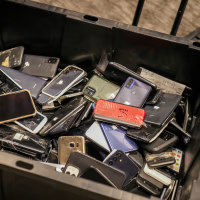
During the visit Carr stood before a display of hundreds of seized phones and several large drones that have been used to ferry contraband over prison fences. “Most people don’t grasp how serious this problem is,” he said, noting that state and local prisons confiscate roughly 25,000 illegal phones each year. “We’re giving law‑enforcement a new tool that should make a dramatic difference.”
Carr cited the 2010 case of Robert Johnson, a South Carolina corrections officer who was seriously injured at his home in a hit that authorities said was coordinated by an inmate using a smuggled phone. After undergoing more than thirty surgeries and living with constant pain, Johnson told reporters on Wednesday that he now refers to those phones as “weapons of mass destruction.” He has testified at several FCC hearings on the issue and said, “No one should have to go through what I went through. I believe God chose my wife and me to carry this banner.”
South Carolina has served as a testing ground for prison‑cell phone jamming. In 2008 the FCC authorized a one‑time trial at a maximum‑security facility, using a briefcase‑sized transmitter that shut down phones inside an auditorium while leaving service outside untouched. A second trial in 2019 involved a joint effort between federal and state officials at a different prison. The test came after a 2018 riot—the deadliest in the United States in 25 years—where seven inmates died in a gang clash that prosecutors say was partly orchestrated with illegal phones.
The commission has been active on the issue for years, holding a field hearing in South Carolina in 2016 and convening meetings with members of Congress, prison administrators and representatives of the wireless industry.
Advocacy groups for inmates have opposed the jamming rule, arguing that the high fees charged for official prison phones push many incarcerated people to rely on contraband devices just to stay in touch with family. The telecommunications sector has also expressed concerns that jamming could interfere with legitimate communications.
Carr said he believes the industry’s stance is softening as the scale of the problem becomes clearer and as agencies experiment with more targeted jamming technologies. “We’re not looking at blanket jamming outside this specific context,” he explained. “The opposition has diminished considerably.”
Meg Kinnard can be reached at http://x.com/MegKinnardAP