
A federal appeals court on Monday refused to halt the Army’s plan to blow up about five tons of lead‑azide explosives stored at a munitions facility in Iowa. The decision follows a temporary injunction the 8th Circuit had placed on the operation last week while it considered a more permanent ruling. The judges concluded that the environmental groups challenging the detonation were unlikely to prevail.
Environmental organizations had warned that the blast could release a cloud of toxic lead particles across the surrounding region and argued that the Environmental Protection Agency had not given the public sufficient notice or fully evaluated the hazards before granting the Army permission to proceed. The government, however, maintains that the material has become unstable and poses a danger of an accidental explosion if left untouched.
President Donald Trump said earlier on Monday that the government would not move forward with the explosion—originally slated for Wednesday—until the appeals court issued its decision and unless Iowa’s governor‑elect, Democrat Rob Sand, gave his approval, even though the governor’s sign‑off is not legally required. Trump added that experts within the administration consider the controlled detonation the safest option. In a social‑media post he wrote, “If [Sand] or the Courts do not agree, we will have no choice but to not proceed with the controlled removal of these hazardous materials, and be forced to hold the incoming Governor responsible for any and all death or destruction caused by this very unfortunate, and long‑term, situation.”
Sand responded on his own social‑media channels, urging the administration to base its decision on the information gathered by the specialists who have been on the ground in Middletown for weeks. “Everyday Iowans are entitled to know how Middletown came to this situation, and learn why the administration believes this is the best path forward,” he wrote.
The Army argues that, even if the court were to suspend the EPA permit, it retains the authority to act without it in order to address the immediate threat of an uncontrolled blast. Officials warn that cold weather could cause the lead‑azide crystals to deteriorate further, raising the likelihood of a spontaneous explosion.
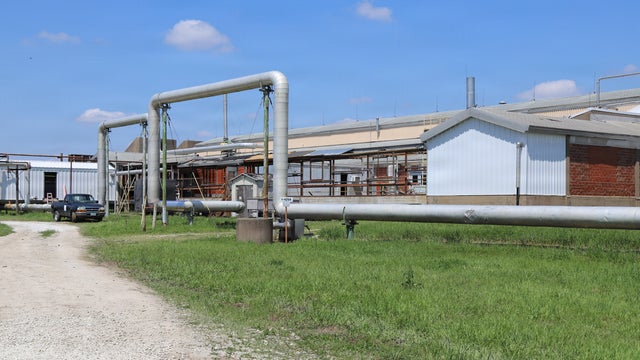
The lead‑azide has been kept for decades in earthen‑covered containers at the Army’s ammunition plant in Middletown, a small community on the Mississippi River in southeastern Iowa. EPA officials disclosed earlier this year that the compound has degraded over time, making it prone to detonation if it is moved or disturbed.
As part of a previously announced schedule for a Friday detonation, the Army asked a portion of Middletown residents to vacate their homes for about six hours, warning them of loud noises, ground vibrations and a dust plume that could be visible in the area.
Both environmental groups and lawmakers from Iowa and neighboring Illinois, representing both parties, have criticized the plan, citing concerns that the explosion could spread lead contamination across both states and urging the EPA and the Army to explore alternative solutions. The Sierra Club and the Iowa Environmental Council petitioned the appeals court to review the EPA’s permit, contending that the blast could generate a lead‑dust cloud that might reach homes and communities as far as 100 miles away.
Those groups also claimed the EPA’s risk assessment was incomplete, that it failed to consider other options, and that the Army’s timeline was “extraordinarily rushed,” leaving residents with inadequate notice.
In its Monday ruling, a three‑judge panel found that the EPA’s permit included sufficient protective measures—such as physical barriers and a monitoring program—to mitigate the hazards, and that the Army had examined a range of alternative courses of action. The court therefore upheld the government’s position and cleared the way for the detonation to proceed.