
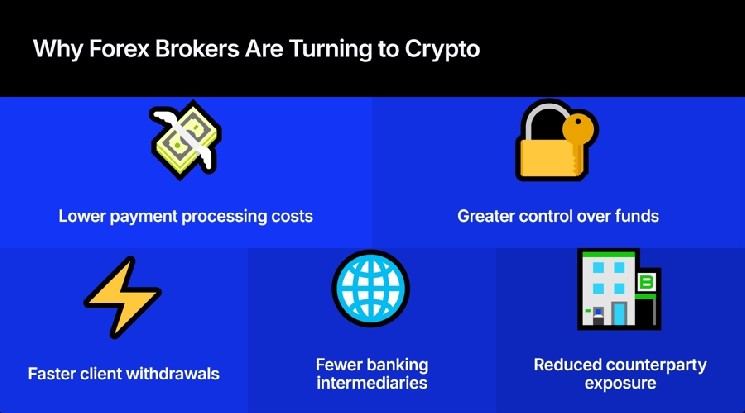
We often hear that bringing digital assets into a financial operation is a slow, drawn‑out process, but foreign‑exchange brokers have shown that it can happen much more quickly. A growing number of firms already accept stable‑coin deposits, and many are rethinking how money moves throughout their entire businesses.
London’s trading sector is essentially coming back home. That shift is possible because the forex model differs fundamentally from that of banks. FX operates as a channel‑driven business, and brokers have never depended on proprietary technology the way banks or fintechs do. Instead, they have long built their platforms by stitching together services from a range of vendors, relying on third‑party intermediaries to handle deposits and withdrawals.
As crypto‑related transaction volumes have risen, a number of mid‑size and large brokers have begun to question that approach. No longer content with merely plugging into payment gateways owned by outsiders, leading forex brokers are now teaming up with crypto‑infrastructure providers to create their own blockchain‑based tools.
Banks traditionally treat their core technology stack—ledgers, payment systems, account infrastructure—as a strategic asset that is built in‑house. Changing any part of that stack is a major undertaking, and digital assets do not fit neatly into such an architecture, turning adoption into a full‑scale transformation project.
Forex brokers, by contrast, grew up with a very different set‑up. Trading is run on platforms like MetaTrader, customer relationship management lives in third‑party CRMs, execution comes from external liquidity providers, and deposits and withdrawals flow through outside payment gateways. In practice, a typical brokerage is a collection of specialised providers linked together via APIs, and its operators are accustomed to integrating disparate systems.
That model’s appeal is obvious: it is cheap and fast to deploy. For small and mid‑size firms, a quick integration can get a new service live in days, which is why this has been the industry norm for years.
However, the economics begin to break down as a firm scales, and the model brings custody and counter‑party risks that can hurt the client experience. Digital‑asset infrastructure can address those pain points, which explains its growing attractiveness.
Because brokers already have extensive experience working with specialised service providers, the transition is far easier for them than for banks. A broker does not need to become a blockchain company to use digital assets; it can simply plug wallet, custody, compliance and transaction tools into the systems it already runs, much as it does with any other third‑party service.
There is an irony in the story: after outsourcing so much of their technology, brokers are now using crypto to bring a critical function back under their own control.
For firms that operate globally, the motivation for digital assets is less about offering a crypto product to clients and more about managing the company’s own cash flow.
Cost is a primary driver. According to a 2026 survey of high‑risk merchants by TheFinRate, processors charge between 3.5 % and 6 % of transaction volume. The median rate cited in the survey is 4.7 %. On a $30 million‑per‑month volume, that translates to roughly $1.41 million in fees each month—a substantial burden.
By contrast, wallet infrastructure is usually priced as a subscription. Cregis, for example, offers a Business tier at $9,700 per year that covers up to $20 million in monthly outbound transfers, with an additional 0.05 % charge on any amount above that limit.
For a broker moving $30 million a month, adding a $400 capacity upgrade would accommodate the extra volume, bringing the annual platform cost to about $10,100 before network fees. Larger capacity purchases can also qualify for volume‑based discounts, further lowering the total expense. The economics are therefore completely different.
Custody risk is another consideration. Under the pooled‑payment‑provider model, brokers must keep large, pre‑funded balances with the payment company at all times. If that provider encounters trouble, the broker—and its clients’ funds—are directly exposed. Holding funds in wallets that the broker controls, governed by its own permission and approval workflows, removes that counter‑party from the equation.
Processors also typically retain around 9 % of monthly volume in rolling reserves. On a $30 million monthly flow, that means roughly $2.7 million sits with a third party.
Customer experience suffers under the gateway model as well. Withdrawals depend on the payment company’s processing times. Even large, regulated brokers experience noticeable delays: FxPro tells clients that international wire transfers take three to five business days, while card refunds can take about ten days; FXCM warns that card refunds may require an entire billing cycle. Such delays create anxiety about the safety and timing of funds, and the broker has little ability to intervene.
With self‑managed wallets, withdrawals can be completed in minutes, allowing brokers to meet the near‑instant expectations that customers have come to expect from major crypto exchanges.
When built properly, a wallet infrastructure becomes the operational layer through which a broker manages balances, moves money between entities and controls treasury across multiple jurisdictions. That capability is especially valuable in forex, where brokers serve clients in many countries, each with its own banking system, currency and payment rails. The more fragmented the footprint, the greater the benefit of reducing reliance on local banking channels and the intermediaries attached to them.
More than half of Cregis’s clientele now comes from outside the crypto‑native sector, with traditional financial firms representing a significant share—and FX brokers forming the largest segment of that group.
Over time, these advantages compound. A broker that owns its liquidity, settlement and treasury flows can launch new products faster because it is not waiting on a partner’s roadmap. It can enter new markets more easily, since it does not need to rebuild banking relationships from scratch in each jurisdiction. And it is less vulnerable when a single bank or payment provider changes its terms or exits a market.
Thus, ownership of the underlying infrastructure shifts from a back‑office convenience to a competitive edge. The firms that adopt this model first will set new expectations for instant funding, predictable withdrawals and fewer excuses, while those that lag behind will find themselves explaining delays that their more advanced rivals no longer experience.
Source: CryptoNews.net