
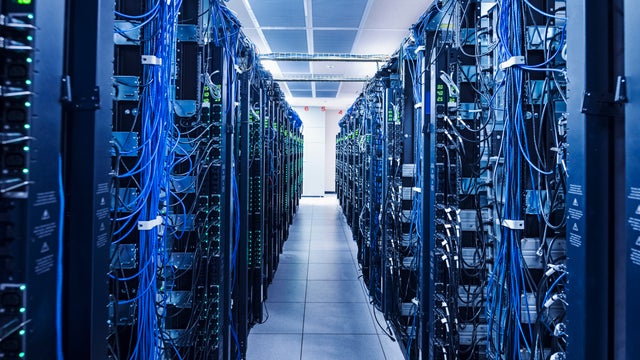
A new Harvard University study shows that the nation’s biggest data centers together use about the same amount of electricity as some individual U.S. states and even whole countries. The researchers focused on “hyperscale” facilities—vast complexes that can cover several football fields—and found that between 2024 and 2025 they consumed roughly 82 terawatt‑hours of power, representing about 1.8 % of the country’s total electricity use. That level of demand is comparable to the annual consumption of a state such as Missouri or a nation like Denmark, and the centers emitted roughly 26 million metric tons of carbon dioxide.
The paper, which appeared this week in *Nature Sustainability*, was led by Harvard scientist Gianluca Guidi. He told CBS News that the team spent two years compiling data on the electricity consumption and carbon output of 403 hyperscale sites from May 2024 through April 2025. Guidi cautioned that the figures are probably conservative, given the rapid expansion of artificial‑intelligence infrastructure across the United States. “Our data stop in April 2025, which in AI terms is already outdated,” he said. He noted that the number of large‑scale data centers operating today is more than twice the count in the study, with another 2,000 facilities either planned or under construction. “The sector is scaling faster than anyone can keep up with,” he added.
The analysis underscores how dependent AI is on these massive data hubs and how significant their environmental footprint is. Guidi explained that virtually every digital activity—sending an email, uploading a photo, streaming a series, or querying a generative‑AI model—passes through such facilities, which house tens of thousands of servers running nonstop. The equipment generates substantial heat, requiring continuous cooling, effectively making the sites “factories that never shut down,” he said.
Although Guidi is enthusiastic about AI’s potential and identifies as a supporter of the industry, he urged greater scrutiny of the timing and methods used to construct new centers. “We shouldn’t wait for evidence of impact after the buildings are already up, nor should we silence public input,” he argued. “There are alternative approaches that might be costlier or take longer, but we need to consider whether we’re chasing profit or what truly benefits society.” He challenged the major cloud providers, stating, “We’ve shown we can roll out AI quickly. Now we need to demonstrate we can do it responsibly.”
At the United Nations climate conference COP31 in Turkey, negotiators introduced a voluntary pledge urging corporations and governments to power AI workloads with cleaner electricity. United Nations climate chief Simon Stiell warned, “We cannot ask citizens to shoulder higher costs, increased emissions, and deeper inequality today in exchange for vague promises of a better future. Assertions about future emission reductions do not justify current pollution that worsens climate risks.” To date, the pledge has not been signed by the leading U.S. technology firms driving the AI expansion.