
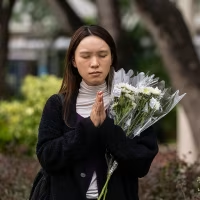
Hong Kong residents gathered on Thursday to honour the victims of the city’s deadliest fire in decades, laying flowers, food and toys while offering prayers. Their tributes came just days after the government cautioned the public to be wary of commemorative events that might be exploited by groups with hidden agendas.
The inferno, which broke out on 26 November 2025, engulfed seven high‑rise blocks in Wang Fuk Court, killing 168 people and displacing thousands more. The scale of the disaster was unprecedented for the affluent financial centre, long praised for its safety standards and modern infrastructure.
A year later, many survivors are still coping with loss as they adjust to temporary housing, arrange funerals, sort through belongings salvaged from the charred apartments and consider long‑term resettlement options.
In a park near the former complex in Tai Po, a steady stream of mourners placed bouquets, snacks and children’s toys at a makeshift memorial. Some lingered to look at the site of their former homes, while others broke down in tears.
One survivor, YN Chi, recalled narrowly escaping the blaze and said she would not be alive if she had delayed her exit by even five minutes. “My greatest wish is to tell the truth about the 168 victims,” she said. “They were innocent. It is a tragedy.”
The tragedy remains a sensitive subject in the Special Administrative Region, and not everyone feels free to discuss it openly. As the first anniversary approached, Hong Kong’s second‑highest official, Eric Chan, warned on Friday that while lawful commemorations would be permitted, residents should choose their participation carefully and avoid being used by anyone seeking to cause disruption. He did not name any individuals but said that some online commenters had openly expressed intentions to organise gatherings or disruptive actions on the anniversary.
China’s Hong Kong and Macao Affairs Office echoed the warning on Tuesday, urging vigilance against attempts to “use the disaster to stir up chaos.” The statement praised the government’s “decisive and pragmatic” response and claimed that many residents were gradually moving beyond the tragedy, expressing gratitude to the authorities and society.
Human Rights Watch’s Asia director, Elaine Pearson, offered a starkly different view, accusing the city government of employing “Beijing‑style tactics” to silence victims’ voices while offering vague promises of accountability.
Kai Chou, a student in Tai Po who watched the flames from a distance, said he felt compelled to remember the victims of what he described as a preventable disaster. He criticised the government’s admonition, questioning whether it treated ordinary citizens as potential “terrorists.” “You made mistakes too, and yet even when we’re just trying to mourn, you still have to say things like this,” the 18‑year‑old said.
Grace Chan, a visitor from outside Tai Po who placed a flower at the memorial, told reporters through tears that the city had changed in ways she could not accept.
Selina Cheng, chair of the Hong Kong Journalists Association, posted on Threads on Wednesday that local media were encountering obstacles in covering the anniversary, noting that a local TV station had not aired its own report on the event.
On the eve of the anniversary, the Hong Kong office of China’s Foreign Ministry emailed international news agencies, including the Associated Press, offering background material on the fire’s aftermath. The message said the government was taking the “weak links” in building maintenance and fire‑safety regulations exposed by the blaze seriously and was committed to reforms and investigations.
Religious services were also held throughout the city. A Wednesday Mass attracted hundreds, many of them bereaved relatives. At a downtown cathedral, the names of all 168 victims were read aloud. Pastor Jenny Lam, who lost three family members in the fire, said that on sleepless nights she wondered how those left behind should move forward, eventually realizing they needed to live well. “It isn’t about erasing our pain,” she said, “but about continuing to experience the beauty of life on their behalf.”
Phyllis Lo, whose mother perished in the fire, said she thought about the victims’ homes and how their families would feel hearing their names recited. She had hoped the government would organise official commemorations, noting that its apology had already arrived too late and that a genuine gesture would show it was truly standing with the victims. “There was disappointment, but I no longer place any expectations on it,” she said.
Earlier, Eric Chan told a radio program that authorities had not organised official commemorations because community‑led events were already taking place.
An official investigation concluded that the fire likely started from a lit cigarette and spread rapidly due to non‑fire‑retardant scaffolding material. The report faulted the renovation work at the complex and highlighted oversight failures across several government departments.
A month earlier, Hong Kong chief executive John Lee and other officials had publicly bowed in apology, and the housing minister had resigned in the wake of the tragedy.
Da Chung, a former resident of Wang Fuk Court who attended the Mass, said she is learning to make peace with the loss, though it remains difficult for many. “Their grief hangs in the air,” she said.