
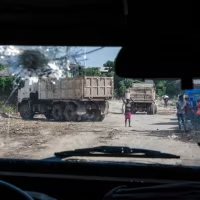
SAN JUAN, Puerto Rico — On Thursday, Haitian armed forces began a large‑scale offensive aimed at dislodging entrenched criminal groups from a vital corridor that links Port‑au‑Prince with the nation’s western and southern provinces.
It marks the first major sweep in five years since gangs took over Martissant, a neighborhood on the western edge of the capital.
The Haitian National Police uploaded a video to X indicating that at least 34 individuals suspected of gang affiliation were killed in Martissant during a clash involving police and a task force that includes personnel from Vectus Global, a private security company founded by former U.S. Navy SEAL and Blackwater co‑founder Erik Prince.
Local outlets reported intense gunfire and the use of explosive drones, while police footage showed armored vehicles moving through the area.
Martissant sits on Route 2, the main artery that carries traffic out of Port‑au‑Prince toward key western and southern cities. Before the gangs seized the district more than half a decade ago, thousands of commuters passed through each day. The takeover crippled commerce, as the criminals blocked the flow of goods, imposed tolls and sometimes opened fire on passing cars and buses.
Since the gangs assumed full control, humanitarian workers and Haitian residents have been forced to rely on alternative routes or remote rural roads.
The struggle for Martissant began in June 2021 when factions from Grand‑Ravine and Village‑de‑Dieu launched an assault on the Ti‑Bois gang. Armed men set fire to homes, killed families, razed businesses and captured the local police station.
The violence displaced at least 19,000 people and affected roughly 800,000 others, according to a United Nations assessment released in July 2022.
A 2023 UN report noted that criminal groups operating between Tabarre and Carrefour were extorting about $380 from anyone traveling through Martissant.
The Center for Analysis and Research in Human Rights in Haiti reported last year that, following the loss of Martissant, hundreds of public and private entities were forced to relocate and more than one million residents were compelled to flee their homes.
While fighting continues in Martissant, a United Nations‑backed anti‑gang task force has also reported recent advances aimed at not only displacing the gangs but preventing their return.
“Operations are moving into a new stage: intensifying pressure on gang networks, dismantling additional strongholds, and extending authority over key locations,” the force wrote on X on Thursday.
The unit said its activities now include work in Tabarre, a suburb of Port‑au‑Prince, and in the central Artibonite region, an area that has suffered repeated attacks by armed groups.
It added that its forces have come under fire while progressing along Route 5, “clearing obstacles set up by gangs that isolate neighborhoods and dominate essential routes.”
The task force also reported that it has secured a church and a school north of Gros‑Morne that had been occupied by gang members.
“It is about restoring freedom of movement, reopening access to public services, and re‑establishing state presence for communities that have endured years of gang domination,” the group posted on X on Sunday.
In addition to Haitian forces, about 2,500 Salvadoran soldiers, deployed last month, are also engaged in combat after four of their troops went missing following an attack on October 18 in the capital.
Acting on orders from President Nayib Bukele, the Salvadoran contingent has targeted the residences of two of Haiti’s most powerful gang leaders, Jeff and Lanmò San Jou, earlier this month, though neither leader was killed.
Thousands of Haitians took to the streets of Port‑au‑Prince and surrounding areas this week to show support for Bukele, but analysts have criticized the unilateral nature of the Salvadoran operations and warned that the use of explosive drones has increasingly resulted in civilian casualties.
A smaller group of Salvadoran personnel is cooperating separately with the UN‑backed anti‑gang force. In late September, El Salvador’s legislature approved a law extending that group’s mission in Haiti for another twelve months, until October 2027. The measure, championed by Bukele, passed overwhelmingly in a congress dominated by his party.
The violence persists as Haiti prepares for its first national elections in more than a decade. The country has been without a president since the assassination of Jovenel Moïse in July 2021.