
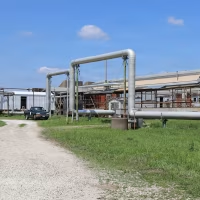
DES MOINES, Iowa — The U.S. Army’s plan to blow up roughly five tons of deteriorated bomb‑making chemicals at the Iowa Army Ammunition Plant has sparked anxiety among residents of southeast Iowa, who fear a cloud of lead‑laden dust could contaminate the environment and pose health risks.
The controlled explosion is scheduled for Friday. Officials have urged people living in a neighborhood of nearby Middletown to leave their homes that morning; those who cannot evacuate are advised to remain indoors with windows and doors shut.
An advisory explains that the blast will generate an airborne plume containing particles of lead that will settle on the ground. “Lead is toxic to humans and animals. This advisory is intended to give the public practical guidance, out of an abundance of caution, to limit exposure to lead,” the notice reads.
Maps released by authorities show the likely drift of lead dust northward toward other towns, and several schools in the projected path have already canceled classes. While Middletown itself houses about 400 residents, the plume could affect thousands more in the surrounding area.
The two detonations will be brief, but officials warn that the shock could shatter older windows in the town. They estimate the dust cloud will linger for no longer than an hour, depending on wind conditions, and have recommended that residents wash their cars and clean windowsills and other outdoor surfaces. Many locals have taken to social media to question whether those measures will be sufficient.
The issue first came to Middletown’s attention in March, when the Army discovered that several dozen barrels of lead azide—an explosive compound used in munitions—had become unstable after the plant halted operations for a review. “The safety of our people and our neighbors is non‑negotiable,” said Lt. Col. Daniel Nosse, the plant commander, acknowledging the material’s volatility.
During an October public meeting, the Army disclosed that a detonation was being planned for an unspecified date in November. The Environmental Protection Agency granted an emergency permit on Nov. 13, clearing the way for the Friday blast. The permit required the Army to model potential air and dust dispersion and to issue a public notice at least five days in advance, which led to Sunday’s alert reaching communities as far as 100 miles (160 km) away.
In Mediapolis, about 20 miles (32 km) northeast of the plant, city officials were approached late last month about conducting soil, water and air testing. They only learned they lay in the center of the projected dust exposure zone when the Sunday notification arrived. The Mediapolis Community School District announced on Tuesday that “uncontrollable variables” forced the closure of schools on Friday, canceling all events and sports practices. The public library will also shut its doors, and the fire department plans to hose down playgrounds that could be coated with lead particles.
The EPA will set up a command center in Mediapolis to sample air, soil and water during and after the explosion, and the city will conduct its own testing to reassure concerned residents. “This is probably a first for me. I believe it’s a first for a lot of our citizens,” said Deputy City Clerk Amy Stucker, noting the community’s frustration over limited information.
Governor Kim Reynolds’ office was briefed on the advisory on Monday, according to her staff. Environmental and public‑health officials in neighboring Illinois have also weighed in, urging the military to carry out extensive sampling in their state after the detonations.
The lead‑azide drums had been stored at the plant for more than two decades in earthen‑covered containers, submerged in a mixture of ethanol and water to keep the compound stable, explained Justine Barati, a public‑affairs specialist with the Army Sustainment Command. A routine inspection earlier this year revealed that some of the liquid had evaporated, causing the lead azide to crystallize. The crystallized material is far more sensitive to friction and shock, creating a “highly unstable and dangerous situation,” according to the EPA’s emergency permit.
Moving the drums was deemed too risky, as any disturbance could trigger an accidental detonation, especially in cold weather, Barati said. “We’re really concerned about the weather situation,” she added. “We’re really concerned that it will detonate on its own.”
To address the problem, the Army assembled a panel of experts in munitions chemistry, engineering and environmental safety to design the blast plan. The barrels are encased on all sides with concrete, which is buried under soil, and two‑story‑high sand barriers have been erected around the site. During the explosion, the soil will be sprayed with water and the air misted to keep as much lead as possible on Army property, Barati said.
Patrick O’Shaughnessy, a professor in the University of Iowa’s Department of Occupational and Environmental Health, praised the Army and EPA for taking steps to limit dust, but cautioned that the exact amount that will become airborne and settle on surfaces remains uncertain. He noted that lead is a neurotoxicant that can impair brain development, especially in young children, and expressed particular concern for toddlers who tend to put objects in their mouths.
EPA documents indicate that alternatives such as chemically neutralizing or decomposing the drum contents were considered, but officials concluded that any approach involving handling the drums would raise the likelihood of an accidental, potentially fatal explosion.