
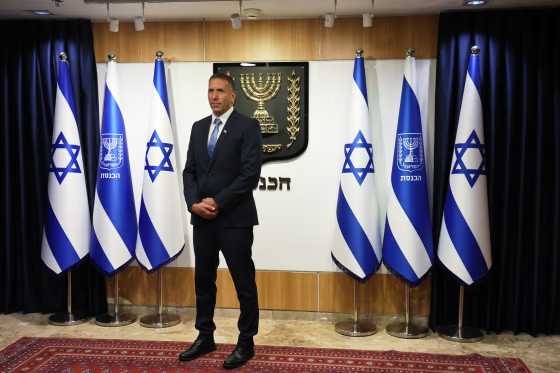
Jerusalem – On Tuesday the Knesset chose a new speaker, a development that could pave the way for undoing many of the measures adopted by Prime Minister Benjamin Netanyahu’s outgoing administration.
The position went to Matan Kahana, who is closely aligned with Gadi Eisenkot, the leader of the party currently tasked with assembling a new coalition and replacing Netanyahu. Eisenkot’s bloc has said it intends to reverse several of the former prime minister’s most controversial policies now that Kahana holds the chair.
Kahana secured 66 of the 120 votes in the chamber, receiving support from both the Jewish‑led opposition and the Arab‑led parties. The candidate favored by Netanyahu’s faction, Ofir Katz, fell short with 52 votes after a protracted, seven‑hour debate.
“The election of Matan Kahana as speaker represents a democratic step forward and reflects a clear majority that wants change,” Eisenkot said before the vote.
The vote came weeks after the 27 October parliamentary election, in which Netanyahu and his allies lost their majority. Following the election, Israel’s president tasked Eisenkot with forming a new government. He now has up to five weeks to cobble together enough partners for a governing coalition.
While coalition talks continue, Eisenkot’s bloc, together with unaffiliated Arab parties, can use their majority in the newly sworn‑in Knesset to push forward a legislative agenda. Last week they introduced a series of bills, including proposals to impose term limits on the prime minister’s office, to launch a government‑led inquiry into the Hamas‑initiated attacks of 7 October 2023, and to repeal recent restrictions on the judiciary.
According to Assaf Shapira of the Israel Democracy Institute, Kahana’s election gives the opposition a significant procedural edge. “The speaker can dramatically accelerate or slow down the legislative process, and time is of the essence,” he explained.
Kahana replaces Amir Ohana, a close associate of Netanyahu, as speaker. Eisenkot and his allies now face pressure to move quickly on their priorities. Roy Folkman, a member of Eisenkot’s Yashar party, currently chairs the interim committee that will oversee much of the Knesset’s work until a formal government is in place.
If Eisenkot is unable to form a coalition, the president could turn to Netanyahu for a chance to build a government, which would likely hand control of the committee to Likud. Even though the opposition would still retain a numerical majority, Shapira warned that their momentum could wane and that “there is a real risk that some legislation will be delayed.”
Procedural hurdles add to the challenge. A bill must be tabled on the floor, examined by a committee, and then voted on multiple times before it can become law, a lengthy process that may make it difficult to pass measures before the window closes.
Shapira expects Eisenkot’s team to focus first on repealing the controversial laws that expanded the government’s role in judicial appointments and curtailed the authority of the attorney general, a position many view as a cornerstone of Israel’s checks and balances. “These changes can be undone relatively easily because they don’t require creating new institutions,” he said.
Creating a commission to investigate the 7 October attack, he added, should be more straightforward and would gain greater legitimacy once a new government is installed. Netanyahu’s opponents argue that he has blocked an independent probe into possible military and intelligence failures surrounding the deadliest day in Israel’s recent history, thereby evading accountability.
The emotional fallout from 7 October was evident in the chamber on Tuesday. During the debate, Likud MK Talik Gvili, whose son—a police officer—was killed by Palestinian militants on that day, interrupted Arab Joint List senior MK Ahmad Tibi as Tibi criticized far‑right Knesset members for racist remarks. “Who is responsible for my son’s death?” Gvili shouted. Tibi responded, “Why are you directing that question at me? Don’t address an Arab MK that way.” A heated exchange followed, with Tibi urging Gvili not to make insinuations. “The murder was carried out by Hamas. The prime minister bears responsibility,” he said.