
Myanmar’s government denounced a recent decision by the United Nations’ top court as “unfair,” saying the ruling that its security forces carried out a state‑sponsored genocide against the Rohingya Muslim minority was unjustified.
Khaing Khaing Soe, a spokesperson for the Burmese administration, told reporters in Naypyitaw on Friday that the judgment was not unanimous and that the country had been wrongly implicated. “Our nation has been unfairly blamed,” he said, adding that the decision “lacks consensus and is not equitable.”
The International Court of Justice (ICJ) issued the landmark judgment, marking the first occasion the court has formally held a state accountable for genocide. The case, brought by the predominantly Muslim Gambia, had been pending for seven years. This is only the fourth instance since the Holocaust in which an international tribunal has concluded that the legal criteria for genocide have been satisfied.
In its findings, the judges concluded that Myanmar’s armed forces carried out mass killings of men and boys, perpetrated widespread sexual violence against Rohingya women, and set fire to or demolished hundreds of villages during so‑called clearance operations.
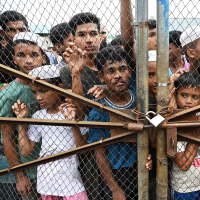
The Rohingya, a largely Muslim group long subjected to persecution in the Buddhist‑majority nation, now endure heightened violence in their conflict‑torn homeland and face deteriorating conditions in the overcrowded refugee camps of neighboring Bangladesh, where about 1.2 million of them reside.
The court ordered Myanmar to provide reparations to the Rohingya for the abuses, with the amount to be determined later, and to facilitate their “safe and dignified return” after the country’s “wrongful acts.” While thousands of Rohingya refugees in Bangladesh’s sprawling camps welcomed the decision, it remains uncertain when they might be allowed to go back.
Although ICJ rulings are final, the court has limited means to enforce its judgments, which typically involve disputes between states and alleged violations of international treaties.
The 191‑page opinion also cited a Reuters investigation into the September 7, 2017 killing of ten Rohingya men in Inn Din and the subsequent detention of two Reuters journalists for more than 500 days.
When asked for a comment on the verdict, Khaing Khaing Soe noted that prominent world leaders have previously warned that “political bodies” like the ICJ should not overstep their judicial authority.