
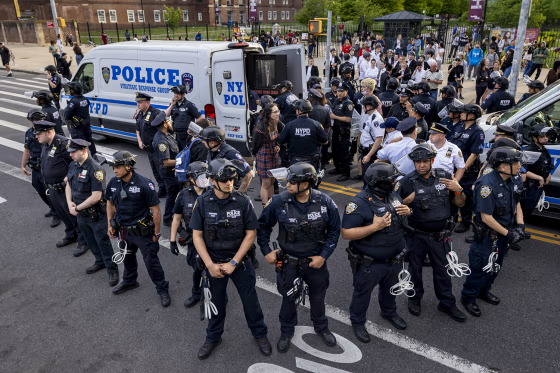
Mayor Zohran Mamdani and NYPD Commissioner Jessica Tisch announced on Monday that the department’s Strategic Response Group will be dissolved. Critics have long described the unit as overly militarized in its handling of large‑scale demonstrations, while supporters argue it is a vital component of the city’s counter‑terrorism strategy.
Mamdani, who has repeatedly said that terrorism investigations and responses to First Amendment activities should not be merged, made the disbanding of the SRG a central promise of his 2025 mayoral campaign. Under the new plan, the two sets of responsibilities will be split. Counter‑terrorism duties will be transferred to the NYPD’s Intelligence and Counterterrorism Bureau.
Beginning in the new year, the city will reorganize its protest‑response framework by creating a civilian‑run Community Dialogue and De‑escalation Division (CDDD) within the Mayor’s Office of Community Safety. Mamdani emphasized that the new division will have no weapons or arrest authority. “New Yorkers exercising their constitutional right to protest should not be met with the same police response as a terrorism threat. We are establishing a new, civilian‑led approach that prioritizes dialogue, engagement and de‑escalation,” he said in a statement, describing the move as part of “building a new approach to public safety.”
To bridge the gap until the civilian unit is operational, the NYPD will form a First Amendment Support Team (FAST) composed of 30 officers trained in communication and de‑escalation techniques. FAST will take the lead on protest‑related incidents in the interim.
The reforms also tighten limits on police tactics during First Amendment events. Mamdani announced that officers will no longer be permitted to use pepper spray as a crowd‑control measure, and that long‑range acoustic devices must be kept below 90 decibels.
Commissioner Tisch praised the changes, saying they are intended to “consolidate our counterterrorism capabilities, provide greater support to our patrol officers and ensure we continue to respond to protests consistent with public safety and the First Amendment.” She added that she would not support any alterations that would weaken the NYPD’s ability to protect residents or leave officers without the resources needed to confront serious threats, asserting that the reforms would make the department “stronger, more effective.”
According to NYPD officials, the SRG was tasked with responding to citywide mobilizations, civil disorder and major events, deploying highly trained personnel and specialized equipment. The unit was also used to bolster police presence in areas experiencing spikes in crime or other conditions.
The SRG has been a contentious presence within the department. It has faced accusations of excessive force and militaristic tactics, particularly in crowd‑control situations. During the 2020 George Floyd protests, the unit was alleged to have unlawfully detained more than 100 demonstrators. A settlement reached in 2023, partly as restitution for those detentions, now governs the circumstances under which the SRG may be deployed, though Mamdani has granted Tisch considerable discretion in its use.
In the same year, the City Council’s Public Safety Committee held a hearing on the SRG. The unit’s representatives did not appear, citing ongoing litigation, and instead submitted written testimony describing the SRG as “comprised of highly trained, well‑vetted and professional police officers” who are called upon in “the most stressful, dangerous and chaotic situations, such as the protests and riots that occurred during the summer of 2020.”
The SRG currently numbers about 600 officers. The mayor’s order calls for their reassignment by mid‑February, once the unit is officially dissolved. Police unions have already voiced opposition. Detectives Endowment Association President Scott Munro questioned the need for change, saying, “Why change it? It doesn’t need to be changed. It’s working. It’s working.”
Civil‑rights advocates, however, welcomed the decision. Donna Lieberman of the New York Civil Liberties Union called it “good news for New Yorkers, good news for public safety, good news for the First Amendment,” noting that complaints filed with the Civilian Complaint Review Board against SRG members had been “off the wall” compared with the rest of the department.
When asked about the plan on Friday, Mamdani assured that response times to large incidents would not be compromised. “I have been very clear the focus of the conversations since being in office has been how to do this in a way that keeps New Yorkers safe and protects their First Amendment rights,” he said.