
Israel’s ground incursion across the cease‑fire’s “yellow line” in Gaza forced many Palestinians to abandon their makeshift shelters, analysts said on Thursday, marking a new escalation that could jeopardise an already fragile truce with Hamas.
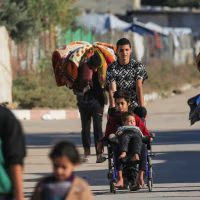
When Israeli tanks entered central Gaza on Wednesday, video and photographs showed residents hauling blankets, mattresses and other belongings away from their tents. Near the Nuseirat camp, people were seen loading mattresses onto carts and helping wheelchair‑bound relatives move out. Palestinian medical sources told Reuters that at least one person was killed by an Israeli air strike close to the area of the raid.
Amna al‑Gasar, 49, told NBC News that she and her young children fled after hearing gunfire. “We heard bullets,” she said, adding that the Israeli army had issued evacuation orders and that tanks were moving toward their neighbourhood. Al‑Gasar, originally from Gaza City, said this was the 14th time her family had been displaced and that they now find themselves on the side of the “yellow line” occupied by Israeli forces. “We are exhausted. This is not a life,” she said.
Muna Abu Shehadeh, 37, said she and several relatives left with nothing but their children, no bedding, food or water. She mentioned that her daughter was ill and that they also had a baby, and that they were forced to abandon the few supplies they had managed to gather.
The Israeli military told NBC News that the operation was the first to be carried out beyond the yellow line – the boundary that encloses roughly 60 % of Gaza under Israeli control – since the U.S.‑brokered cease‑fire took effect in October 2025. In a joint statement with the Shin Bet security agency, the Israel Defense Forces described the raid as a “targeted” effort to destroy a tunnel they said posed an “immediate and direct threat” to Israeli troops. The statement claimed civilians had been warned before the attack, but did not specify how the warning was delivered or whether it went beyond an online notice, a question NBC News raised without receiving a detailed answer.
The Israeli spokesperson said forces would keep operating to eliminate any immediate danger and to prevent Hamas from harming Israeli civilians or soldiers. Later on Thursday, a military spokesperson said the operation west of the yellow line had concluded, though no precise end‑time was given. Hamas denounced the raid as a breach of the cease‑fire, and Andreas Krieg, a senior lecturer at King’s College London’s School of Security Studies, called it a “clear violation of the fundamental premise of the cease‑fire.” He noted that Israel had agreed to stay behind the yellow line as a mutually understood boundary pending further withdrawals, and that moving troops a few hundred metres beyond that line and displacing civilians undermines the agreement. Krieg added that Israel’s claim of an imminent threat had not been independently verified and that the incursion threatens the significance of the yellow line as a cease‑fire marker.
The Israeli government and military did not immediately respond to requests for comment on the alleged breach.
Since the truce began, regular Israeli strikes have killed more than 1,600 people in Gaza, according to the Palestinian Health Ministry, while Israel says at least five of its soldiers have been killed in the same period, Reuters reported. Both sides have repeatedly accused each other of violating the cease‑fire.
Rob Geist Pinfold, a defense studies lecturer at King’s College London, said Israel has been breaching the truce intermittently since it started, but the current ground assault and the use of tanks represent a notable escalation. Both Pinfold and Krieg observed that the operation comes amid political uncertainty for Prime Minister Benjamin Netanyahu, who faces the prospect of losing his premiership after last month’s elections. Although Netanyahu’s Likud party received the most votes, President Isaac Herzog asked rival Gadi Eiskenot to try to assemble a coalition, citing his perceived greater chance of success. Netanyahu has publicly opposed the inclusion of Arab‑led parties in any coalition, and the scholars suggested he may be using heightened security concerns to apply political pressure.
Pinfold speculated that Netanyahu might be testing how far he can push the Gaza front, especially as the United States appears to be distancing itself from Israeli involvement in the war with Iran. Krieg added that Israel may be probing how much leeway it can enjoy from the United States without provoking a strong reaction, possibly seeking to create a precedent for a permanent “right of hot pursuit” beyond the current yellow line as peace efforts stall.
In a separate development, the board overseeing the U.S.‑brokered cease‑fire – known as President Donald Trump’s Board of Peace – delivered a grim assessment to the United Nations Security Council on Tuesday, warning that the fragile agreement was at risk of collapse. The board urged both Israel and Hamas to honour their commitments, but noted that Hamas’s disarmament and its demand for a full Israeli withdrawal from Gaza remain major obstacles, according to a Reuters copy of the report.
Speaking after fleeing the area of Wednesday’s ground operation, al‑Gasar said Palestinians simply need a solution. “All we ask for is safety and security. We’re not asking for much,” she said. “The media talks about progress in negotiations, yet what we see is the advance of tanks.”