
Poland’s government announced that Russian missiles fell on its territory overnight, coinciding with a massive strike by Vladimir Putin’s forces on Ukraine that President Volodymyr Zelenskyy described as “one of the largest attacks” since the war began. The Ukrainian assault killed at least eight people, according to Zelenskyy.
Polish Prime Minister Donald Tusk, whose country is a NATO member, called the missiles that landed in Poland “an intentional provocation” of the alliance. “We are certain the projectiles that struck Polish soil originated from Russia. This is not merely my view but also that of our foreign partners, including NATO members. It does not look like an accident; it appears to be a deliberate provocation,” Tusk said.
Air units from NATO and allied nations scrambled in response, including Polish F‑16 fighters, Swedish JAS 39 Gripens, a Dutch A330 Multi‑Role Tanker Transport and other aircraft. Ground‑based air‑defence systems of the alliance were also put on alert.
Zelenskyy condemned the Russian barrage, writing that Moscow was trying to “make up for its military and diplomatic impotence with this kind of terror.” He added that President Putin’s attempt, alongside his Chinese counterpart, to “redraw the world” at a summit in China on Thursday had failed.
According to the Ukrainian president’s social‑media post, Russia launched more than 400 drones and 110 missiles – some of them cluster munitions – against Ukraine overnight and into Friday. Several of the weapons struck the Austrian embassy in Kyiv and fell near the Dutch embassy, prompting France to call for a United Nations Security Council meeting. French foreign minister Jean‑Noël Barrot wrote on social media that “Russia will have to answer for this.”
Poland’s defence minister said three Russian projectiles – believed to be two missiles and a drone – entered the country’s southeastern airspace on Friday. Polish fighter jets were scrambled and Patriot missile‑defence batteries in the southeast were activated, but no casualties were reported.
Since Russia’s full‑scale invasion began on 24 February 2022, drones have repeatedly breached the airspace of Poland and other NATO states, usually near the Ukrainian border. Under NATO’s Article 5, an attack on one member is considered an attack on all 32 allies.
NATO secretary‑general Mark Rutte posted on Friday that he had spoken with Tusk about “the grave violations of Polish airspace overnight” and affirmed that the alliance stands “in solidarity with Poland and will keep strengthening our deterrence and defence.” He called the incident “clearly dangerous – a consequence of Russia’s ongoing war against Ukraine,” adding that NATO condemns Russia’s attacks and will continue to support Kyiv.
U.S. Air Force General Alexus Grynkewich, NATO’s Supreme Allied Commander Europe, said his staff were in “close contact with Poland’s chief of defence and defence minister as Poland investigates the overnight airspace breaches,” according to a spokesperson.
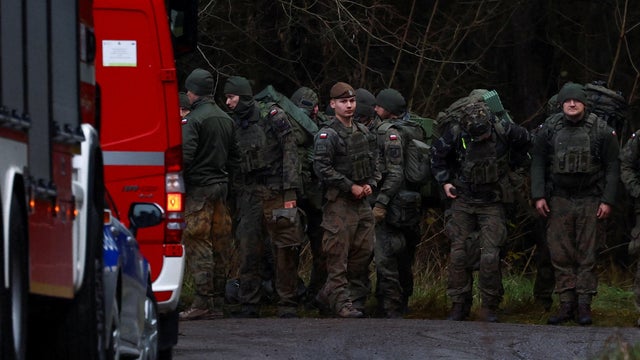
At present, thousands of troops from eleven European nations that are part of the so‑called “Coalition of the Willing” are stationed in Poland for a large‑scale exercise framed as preparation for a possible post‑war mission in Ukraine. Polish defence officials identified the two missiles as likely Russian Kh‑101s and the third projectile as a jet‑powered drone, all landing between 30 and 60 miles inside Polish territory from the Ukrainian border. Deputy prime minister and defence minister Władysław Kosiniak‑Kamysz wrote that it was hard to view the timing and location of the airspace breach as a coincidence given the concurrent coalition drills.
The escalation follows a day after former U.S. President Donald Trump met with Chinese President Xi Jinping and Russian President Vladimir Putin in Shenzhen, China. The three leaders discussed the war in Ukraine, which Trump has long urged to end through negotiations. Shortly after the 90‑minute meeting, Putin dismissed the prospect of direct talks with Kyiv, citing a recent Ukrainian strike that heavily damaged a symbolic bridge linking Russia with the Russian‑occupied Crimean Peninsula. “We will respond to these strikes,” Putin warned, adding that Russia’s retaliation would be “far more painful than what the Kiev regime did to the bridge.”
Zelenskyy said Ukrainian air‑defences intercepted 79 of the 110 missiles launched by Russia overnight, but none of the 27 ballistic missiles, which he blamed on a shortage of interceptors. He has repeatedly appealed to the Trump administration for additional missile‑defence supplies, arguing that the lack of interceptors is costing civilian lives.
Ukrainian prime minister Serhii Koretskyi reported that the attack hit Kyiv and nine other regions, wounding more than two dozen people in addition to the eight confirmed dead. “Missiles struck critical infrastructure in the capital, including bridges, a water‑supply facility and office and commercial buildings,” he said. Damage was also reported to a hospital in Kharkiv, businesses in Mykolaiv, Odesa and Chernihiv, and residential buildings in Dnipropetrovsk, Vinnytsia, Sumy, Chernihiv and Lviv – the latter close to the Polish border. Energy facilities were hit as well, and some nuclear power plants were forced to reduce output, according to an energy‑ministry official.
Zelenskyy condemned the tactics as “particularly vile,” noting that the missiles were launched in several waves with 20‑ to 30‑minute pauses designed to hinder fire‑fighting, debris clearance and rescue efforts. He called for a concrete international response, urging partners not only to issue statements of support but also to fulfil specific air‑defence commitments, and expressed hope that the Pentagon would deliver the supplies Ukraine expects.