
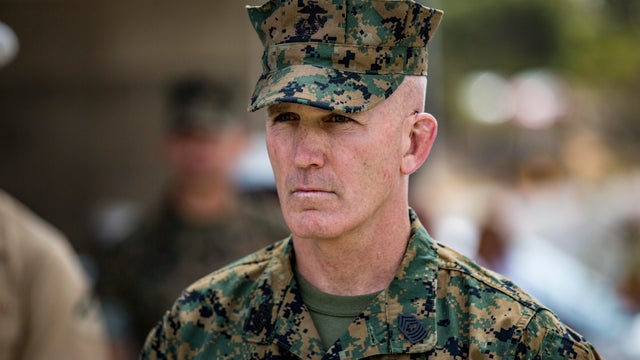
Henderson, Nevada — A Marine Corps veteran whose actions in Iraq earned him the nation’s second‑highest combat valor award is now the focus of a federal criminal probe, CBS News has learned.
Retired Sergeant Major Bradley Kasal, who spent 34 years in the Marine Corps, is being investigated by the Naval Criminal Investigative Service, the Navy and Marine Corps’ principal federal law‑enforcement body.
The specific accusations have not been released by NCIS. Federal officials, however, told CBS News that the inquiry centers on Kasal’s time as a Junior Reserve Officers’ Training Corps instructor at the Basic Academy of International Studies, a public high school in Henderson run by the Clark County School District.
The investigation marks a stark shift for a man whose battlefield deeds made him a symbol of Marine bravery. A 2004 photograph from the second battle of Fallujah shows Kasal, drenched in blood, being helped out of a building by two fellow Marines. Though his right leg was broken and his body riddled with bullet and shrapnel wounds, he still clutched a pistol and a combat knife. The image was later cast in bronze statues placed at two Marine installations. Kasal retired after three decades and a half of service, receiving two Purple Hearts and the Navy Cross, the second‑most prestigious combat award after the Medal of Honor.
On Wednesday the Marine Corps confirmed to CBS News that it is aware of “the allegations against a retired Marine Sergeant Major that arose while he was employed as a civilian JROTC instructor at the Basic Academy of International Studies.” The Corps added that NCIS is “actively investigating the allegations as the Department of the Navy’s lead for felony‑level criminal investigations.”
Denise Caskey of NCIS also confirmed that the agency’s field office at Camp Pendleton, California, is handling the case. NCIS rarely acknowledges ongoing investigations, making this instance unusual. The service typically probes homicides, sexual assaults, fraud, terrorism, espionage and counter‑intelligence matters.
Kasal did not respond to multiple requests for comment.
CBS News spent two weeks in Henderson speaking with roughly 40 people, including former cadets, school‑district staff, city officials, parents, active‑duty service members and Marine veterans who served with Kasal. Several sources asked to remain anonymous because they were not cleared to speak publicly or feared retaliation.
Many of the cadets interviewed said Kasal often gave rides home to a select group of female students, took them to coffee shops and spent time with them outside of school‑sponsored events. Some described occasions when he was alone with a cadet in a room.
A former district employee told CBS News that Kasal was cautioned several times about how his relationships with students might be perceived and was warned not to place himself in potentially compromising situations, such as being alone with a cadet.
One former female cadet recounted forming an unusually close bond with Kasal after meeting him in 2020 at age 14. She said she confided in him about family troubles and romantic relationships. Within a year, Kasal texted her an offer to adopt her, saying, “I’m not asking as charity. I’m asking because you wanted.” When her family learned of the proposal, they made clear that adoption was not an option. The cadet said she continued to confide in him about personal matters, including rumors about her sexuality and issues she believed stemmed from her relationship with her father. She now believes those conversations were inappropriate for an instructor‑student relationship.
She also alleged that Kasal invited certain cadets to his home and to a cabin, including for a birthday celebration, and that he regularly drove one student home.
The Clark County School District said Kasal was hired three months after his retirement, in August 2018, and that he resigned in August 2025. The JROTC program at the Basic Academy typically enrolls about 135 students and is overseen by a senior Marine instructor and a senior enlisted leader.
When Kasal moved from active duty to the high‑school program, he sought to reshape it to mirror military standards more closely. Some former cadets praised his professionalism, noting that he instituted strict expectations and brought a disciplined atmosphere. They also highlighted the personal time, energy and resources he invested in the students.
Samantha Francisco, 22, who participated from 2018 to 2022, said, “I can’t say enough about how outstanding he was. He genuinely cared about everyone and taught us invaluable lessons.” She added that she and her husband, also a former cadet, still discuss Kasal weekly.
Ashley Vazquez Romo, 22, recalled that Kasal “gave his heart and soul to the program,” sometimes covering costs for outings and buying equipment such as a CPR mannequin for practice.
Damien Greenwell, 22, who was in the program during the same period, expressed deep respect for Kasal’s service and mentorship, especially for students from troubled homes. He also said he had, at times, questioned Kasal’s conduct, noting that even well‑intentioned actions could appear improper to an outside observer.
“He would mentor us on leadership, which was his role, but he sometimes went beyond that. He helped people in need, which is commendable,” Greenwell said. “If someone couldn’t afford a meal, he would pay for it. If someone needed a ride home, he would help. That’s great, but regularly buying Starbucks for a girl … it looks odd, and driving students home repeatedly raises concerns about boundaries.”
Greenwell recounted a night in 2024, two years after his graduation, when he saw Kasal’s truck at a Lowe’s parking lot around 9 p.m. and observed Kasal walking with a student he believes was a senior or recent graduate. He described the scene as “really weird,” noting that he exchanged brief greetings before they continued down an aisle. The student’s name was withheld for privacy.
He said that over the years he grew uneasy about Kasal’s behavior, wondering whether the optics could be misinterpreted, yet he felt powerless to speak up.
Daniel Gillian, another alumnus who later enlisted in the Marine Corps, said the JROTC experience gave him structure and discipline and credited Kasal with helping him become a better person. He said he never witnessed any inappropriate conduct and saw Kasal’s efforts to create memorable experiences through hikes, camping trips and other extracurricular activities. Gillian noted that Kasal sometimes favored certain cadets, buying them coffee, but he did not view that as improper, describing Kasal as “a nice guy.” He also mentioned that Kasal occasionally organized hikes without formal school approval, arguing that the short distance and quick turnaround made the paperwork unnecessary.
A former male cadet who joined in 2019 and now serves in the military said Kasal once invited him to spend a summer at his cabin in Iowa. The invitation was not school‑sponsored and was intended for just the two of them. The cadet declined because he was playing a sport that summer and did not consider the offer inappropriate at the time, believing it stemmed from a shared athletic interest.
Greenwell said he had heard a rumor that Kasal was trying to adopt a cadet, which he dismissed until CBS News confirmed the former female cadet’s claim. He said he was “very surprised, shocked and disappointed,” adding that even with good intentions, the situation looks bad because the student was a minor.
JROTC programs are jointly overseen by the Department of Defense and local school districts. While districts employ the instructors, the military branches certify them and monitor compliance with service standards. Instructors must sign an acknowledgment that they will not engage in prohibited conduct with students, which bans personal, intimate or sexual relationships, inappropriate communications and unsanctioned social gatherings. The restrictions apply from the first contact with a cadet until six months after the student leaves the program.
The rules generally prohibit instructors from giving personal rides to individual students, except when safety or welfare concerns arise or for official school events involving multiple students. Instructors also may not host cadets in their homes. Purchasing coffee for students is not expressly forbidden, but such gestures can raise questions about compliance. Instructors must sign the acknowledgment before starting and renew it annually.
When CBS News first received the tip about Kasal, the Marine Corps confirmed it was aware of allegations and an investigation, but did not mention NCIS involvement. The Henderson Police Department initially said it had no record of a complaint. The Clark County Detention Center and the District Attorney’s Office also reported no complaints when contacted.
Later, a Henderson police spokesperson said the Clark County School District Police Department was handling the matter. Multiple attempts to reach the district’s police and administration went unanswered. Lt. Bryan Zink of the district police referred inquiries back to the district. An email mistakenly sent to a human‑resources manager asked the reporter to “disregard the request.” When CBS News followed up, public‑information officer Bryan Callahan replied, “We are looking into your request.” He later told a reporter he was unaware of any investigation by the district or its police.
Kasal’s wartime actions have been widely documented. The second battle of Fallujah in November 2004 was the bloodiest Marine engagement since Vietnam, involving intense house‑to‑house fighting. In a 2018 interview with CBS’s David Martin, Kasal described entering a building to rescue trapped Marines, being shot seven times, shielding a wounded comrade from a grenade, and refusing medical aid until others were treated. Those deeds earned him a second Purple Heart and the Navy Cross.
The iconic photograph of Kasal became a symbol of Marine resilience, inspiring a bronze “No Man Left Behind” monument placed at Camp Pendleton, California, and Camp Lejeune, North Carolina. The sculpture was created by John Phelps, a Navy Vietnam veteran whose son died in Iraq in 2004.
When CBS News first learned of the investigation earlier this month, Kasal was in New York as a guest of honor at a NYPD Marine Corps Association event commemorating the Marine Corps’ 251st anniversary and honoring Marines who also serve as city police officers. The New York Post reported that NYPD Commissioner Jessica Tisch presented him with a framed retirement shadowbox at police headquarters.
James LaPorta reported from Henderson, Nevada; Julia Kimani Burnham and Eleanor Watson reported from Washington, D.C.
Editor’s note: James LaPorta has served as a judge for the Marine Corps Heritage Foundation awards for three years but has never judged the award named for retired Sergeant Major Bradley Kasal.