
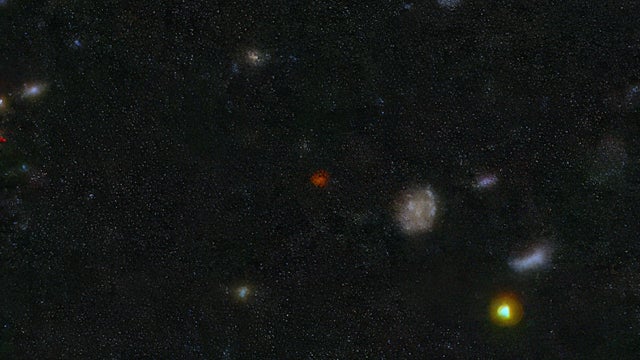
Cape Canaveral, Fla. — A team of astronomers has identified the most distant quasar known to date, a galaxy’s bright nucleus powered by a relatively sluggish black hole that existed almost at the beginning of the universe.
According to a German‑led collaboration that released its results on Tuesday, the quasar formed roughly 630 million years after the Big Bang. In a universe now estimated to be 13.8 billion years old, this pushes the known frontier of quasar formation back significantly, surpassing earlier records.
“This represents a huge step back in cosmic time,” said Julien Wolf of the European Southern Observatory, who headed the investigation, in an email. “The two previous record‑holders each moved the boundary by about fifteen million years or less. This new object extends it by nearly forty million years, the biggest jump we’ve seen in almost ten years.”
Wolf’s group uncovered the object while sifting through the massive data set collected by the European Space Agency’s Euclid mission. Launched in 2023, Euclid is mapping distant galaxies to improve our understanding of dark matter and dark energy and how they drive the universe’s expansion.
Locating a quasar at such an early epoch is uncommon, Wolf noted, and this one is especially unusual because its central black hole is both massive and accreting material at a modest rate. The light we now observe left the quasar about 13.1 billion years ago, when the cosmos was less than five percent of its present age.
Wolf has informally called the quasar “Dun Aonghasa,” after the ancient stone fort on Ireland’s Aran Islands. His wife and daughter are Irish, and a visit to the site inspired him; he likened the fort’s sense of an open, unexplored horizon to the discovery of the quasar.
Observations from the Hubble Space Telescope, the James Webb Space Telescope, and several ground‑based facilities confirmed the team’s findings. Webb data indicate that the black hole fueling the quasar has a mass equivalent to about 360 million suns—a staggering figure for an object that existed so early in cosmic history. The full analysis is published in the journal *Astronomy & Astrophysics*.
“Dun Aonghasa sets a new benchmark for the early universe,” Wolf said. “Only 630 million years after the Big Bang, its black hole had already reached roughly 360 million solar masses. The question is how it grew so quickly.”
The search for even earlier objects continues.
“Honestly, this record might be broken in the coming months, or it could hold for a long time,” Wolf added.