
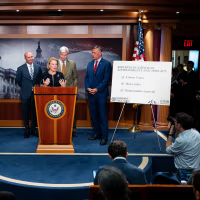
WASHINGTON — On Thursday night, the Senate approved a broad measure aimed at streamlining and revamping the permitting process for energy and infrastructure projects, voting 62‑33 in favor.
The legislation, titled the Bipartisan American Affordability and Jobs Act, was put together by an unlikely group of senators: Republican Shelley Moore Capito of West Virginia, Democrat Sheldon Whitehouse of Rhode Island, Republican Mike Lee of Utah, and Democrat Martin Heinrich of New Mexico.
Among its provisions, the bill would tighten timelines for environmental reviews, speed up the development of electricity transmission lines, limit federal agencies’ ability to cancel existing permits, and cut through bottlenecks that delay project approvals and completions.
Republicans framed the proposal as a way to cut excessive government red tape. “For far too long, essential investments in our nation’s infrastructure, energy production, and economy have been stalled by endless paperwork, overlapping reviews, and regulatory uncertainty,” Capito said.
Democrats, meanwhile, argued that the changes would help move forward long‑delayed projects—including clean‑energy initiatives—and ease rising costs. “Democrats are focused on lowering energy prices, cutting emissions, and ending the free‑ride that data centers enjoy,” Whitehouse said. “If this legislation passes, Americans should see some relief soon.”
To address concerns about data‑center impacts, the bill would require any new facility of 20 megawatts or more to cover the full incremental cost of the infrastructure built to serve it, according to the Bipartisan Policy Center.
The proposal has drawn criticism from several environmental organizations and Native American tribal groups, which say loosening review and consultation requirements could undermine protections for their interests. Most of the Senate opposition has come from Democrats.
Nevertheless, the move to simplify permitting marks a notable shift for the party’s leadership, reflecting a recognition among liberal policy analysts that existing regulations can impede their own climate and energy goals. “This eliminates many of the hurdles that have held back President Biden’s climate initiatives,” said Adam Jentleson, a former Senate Democratic staffer and founder of the Searchlight Institute. “A significant portion of the Inflation Reduction Act’s projects have been stalled by procedural delays.”
The measure now heads to the House of Representatives. Majority Leader Steve Scalise, a Republican from Louisiana, expressed confidence that Congress will move the bill forward. “We want legislation to clear both chambers,” Scalise told reporters when asked whether the House would consider the Senate version. “The specifics matter, of course. We hope the House returns a workable bill, and if not, we’ll negotiate the differences. Our goal is to get a bill to the president’s desk, and that still looks promising.”
Senate Majority Leader John Thune, a Republican from South Dakota, said the most straightforward route to lawmaking is for the House to adopt the Senate’s text and pass it, noting the bill has already undergone extensive debate. “It’s been litigated for months and continues to be,” Thune told reporters. “Procedurally, things get more complex as it moves back and forth, so we hope there’s enough momentum in the House to carry it through. It’s gone through the full legislative process.”