
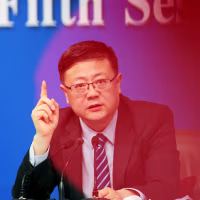
He had been climbing the ranks of China’s political elite, entertaining technology executives and senior U.S. officials, until Shanghai’s party secretary, Chen Jining, a member of the powerful Politburo, was suddenly caught up in President Xi Jinping’s sweeping purge.
The announcement came on Tuesday in a brief Xinhua bulletin that said Chen was “suspected of serious violations of Party discipline and law and is currently under disciplinary review and supervisory investigation.” That phrasing is the standard euphemism for a corruption probe of a Communist Party official under Xi’s rule.
Such notices usually signal the end of a political career in China, and Chen has not spoken publicly since the notice was issued.
Chen is the fourth Politburo member to be removed in under two years, part of a broader crackdown that has also taken down senior military figures as Xi tightens his grip on power. The purge comes ahead of the party congress scheduled for next year, a gathering held every five years that will shape the leadership for the next term.
Observers said the speed of Chen’s fall was unexpected given his high profile and seemingly promising trajectory. “He was potentially going to the highest level, which would be the standing committee. And I think from a lot of Western observers, people thought he had even better prospects,” said Damien Ma, director of the Carnegie China think tank, speaking to NBC News.
Some analysts have suggested that Xi, who appears set to rule for life, may be eliminating a possible successor. Steve Tsang, director of the SOAS China Institute in London, countered that while Chen could have risen further, he was not being groomed as Xi’s heir.
Born in 1964, Chen is a technocrat with a background in environmental science. He studied in London, earned a doctorate from Imperial College in 1993, and returned to Tsinghua University, where he later served as president from 2012 to 2015. He has published dozens of papers on carbon‑reduction and water‑quality monitoring and was known for riding a bicycle around campus and pushing reforms during his university tenure.
After his time at Tsinghua, Chen entered the government as environmental minister, then became mayor of Beijing in 2017, overseeing the 2022 Winter Olympics amid the pandemic. Later that year he was transferred to Shanghai, taking the post of party secretary—a position once held by Xi himself and traditionally viewed as a stepping stone to higher office.
In Shanghai, Chen cultivated close ties with the tech sector. He welcomed Apple chairman Tim Cook in January, urging the company to “make full use of Shanghai’s strengths” and expand its product presence in the city. He also hosted Elon Musk in 2023 to discuss Tesla’s operations, accompanied Xi to an AI hub, and met with several European tech leaders in recent months. During a visit to a shipping facility last week, he called for accelerating the industry’s digital transformation.
By Wednesday, Chen’s name had been scrubbed from several official web pages; a Shanghai government site that once listed his meeting with Cook now returned a 404 error.
His removal adds to a series of high‑level disciplinary actions that analysts say are as much about loyalty to Xi as they are about anti‑corruption. “It is a warning to all technocrats, as Chen was a rising star among technocrats and had no apparent failures in a technocratic way. So, the message is: adhere to strict party discipline and demonstrate unquestionable loyalty to Xi or else,” Tsang said.
At the Party’s recent fifth plenum, the Central Committee—about 200 senior leaders, mostly men—pledged to “ensure more rigorous discipline enforcement, and make full use of discipline as a guide, restraint, guarantee, and incentive.” Ma explained that the party has been building a “discipline machine” over the past 15 years to deal with “bad eggs” inside the organization, and that anti‑corruption has become a normalized, self‑cleansing process expected at every level.
The Politburo, which originally comprised 24 members when it was formed in 2022, now has 21 after a string of purges. Last month, General Zhang Shengmin was added in a rare expansion. Chen, who was the youngest member of the body, has not been formally charged, and his removal from the Politburo list underscores the seriousness of the investigation.
His downfall occurs a year before the 21st Communist Party Congress, when Xi is expected to cement his control further and secure another five‑year term. Whether Chen’s ouster will hinder China’s technology ambitions, particularly its race for AI dominance, remains uncertain. Ma noted that the episode forces analysts to rethink the criteria for rising to power in modern China. “Part of it is thinking through what is really the new criteria to get to the top, and they may not be what we thought just a few months ago.”