
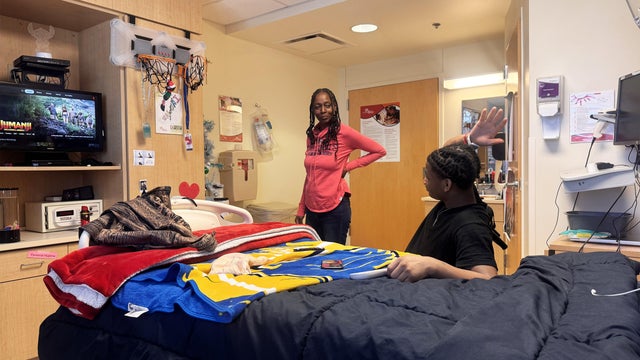
St. Louis — When Jaloni first arrived at SSM Health Cardinal Glennon Children’s Hospital, he was placed in room 3005. The space was stark at the time—no posters, no snacks, and he hadn’t yet learned that a morgue lay beneath the building. The 14‑year‑old was in excruciating pain from fresh gunshot wounds, and the first night he could barely shift his body. Powerful pain medication made him feel as if he were drifting in a dream, like he was flying.
Outside the hospital, Jaloni had been known among his friends as a daring risk‑taker who could steal without getting caught. Inside, he became a boy who needed his grandmother’s reassurance that everything would eventually be okay. That promise, however, was impossible for anyone to guarantee.
Over the next three years, Jaloni spent more than 475 days at Cardinal Glennon, according to his medical records. A portion of that time was not driven by medical necessity but by the fact that he had nowhere safe to go. He asked KFF Health News to use only first names or nicknames to protect his family’s safety.
Jaloni’s experience illustrates a broader phenomenon known as a “social stay” or hospital boarding, where children remain in hospitals beyond the point of medical need. A shortage of appropriate foster‑care placements often leaves children with mental‑health challenges, chronic illnesses or disabilities stuck in medical facilities. A Minnesota study estimated that boarding a child with complex needs cost roughly $3,932 per day in 2017. It is unclear how much of Jaloni’s stay fell into that category or what the exact cost was. SSM Health declined to provide specifics, but spokesperson Liz Sharpe‑Taylor said the system bears “extensive uncompensated costs” when patients cannot be discharged because no alternative exists.
State data show that Missouri has spent more than $64.7 million in the past five years on boarding children in state custody who lack a place to go. Missouri Hospital Association’s Dave Dillon warned that the figure likely undercounts the problem, noting that hospitals often lack staff to track and request reimbursement for such housing. Those numbers also fail to capture the emotional toll on the children involved.
Jaloni’s first admission began in June 2023 after bullets pierced his right arm and the right side of his chest. He was grateful to be alive, though he had already been surrounded by death. An older sister and a 17‑year‑old brother had both been killed in shootings, and several cousins had also fallen victim to gun violence in the St. Louis area. “There was a lot of dying going on,” he recalled. “People were dropping like flies.”
He narrowly avoided becoming another statistic one summer evening when a neighborhood gunfight left a 22‑year‑old dead and a 16‑year‑old charged. “I felt like I was Superman with my gun,” Jaloni said, adding that he later realized how foolish that mindset was.
After three weeks, doctors discharged him to a rehabilitation center, and then he returned home. His mother, Quette, and his grandmother—who had been his legal guardian since childhood and was herself a double amputee in a wheelchair—found caring for a teen who now needed a wheelchair overwhelming. Quette, who also worked as a paid caregiver for another family, said she repeatedly told hospital staff she could not manage the constant bandaging, turning him every four hours to prevent pressure sores, cooking, cleaning and other daily tasks. “I just couldn’t take care of him anymore,” she said. She pleaded for assistance that never arrived. In November, Jaloni developed what appeared to be an infection and severe bedsores, prompting a 911 call.
Less than five months after his discharge, he was readmitted to Cardinal Glennon. Hospital officials told his mother, “Well, y’all almost killed him.” The family faced neglect accusations, and because they lived across the river in Illinois, Jaloni became a ward of that state, preventing him from returning home. Quette considered asking an ex‑boyfriend or other relatives to watch him, and a social worker suggested a placement in Chicago. Jaloni refused, insisting he wanted to stay closer to home. He remained in the hospital while adults sorted out a permanent solution, ultimately staying an additional 250 days.
Finding suitable housing for a wheelchair‑bound teen proved difficult. He needed a place with ramps or elevators, space for medical equipment and someone able to provide constant care. Nationwide, similar challenges are evident. In the fiscal year ending June 2025, Illinois recorded 304 youths boarding in psychiatric hospitals beyond medical need and 312 who spent more than a day in emergency departments waiting for a safe placement. Missouri reported 648 youths in its custody boarded in hospitals during the fiscal year that ended in June. State legislators have introduced several bills to address the issue, but none have succeeded so far.
During his prolonged stay, Jaloni’s grandmother, who had been his main source of stability, died in 2024. His aunt, Deborah—whom he calls “Tete”—agreed to become his foster parent. Deborah moved into a first‑floor, one‑bedroom apartment with a wheelchair ramp and arranged for a specialized hospital bed. Jaloni stayed at the hospital until the new home was ready.
Hospital staff tried to make his long confinement more bearable. Nurses braided his hair, gave him small gifts, and a teacher visited five days a week to support his online high‑school coursework. He described himself as a de‑facto therapist for the staff, listening to their personal stories. To combat cabin fever, the hospital rotated him to a different room roughly every month; he eventually slept in almost every third‑floor room. When asked whether he wanted to avoid room 3005—the room where he first arrived after being shot—he smiled and said it had become a good place for him.
He spent time exploring the facility, playing Fortnite at the nurses’ station, eating in the cafeteria, and stepping outside for fresh air. He learned about a basement morgue where a 13‑year‑old girl who had just died left him a bracelet. “They have a basement downstairs with a morgue in it, lots of dead bodies,” he said in March. “Someone just died the other day. She was 13.”
A friendly custodian, a chatty cook, and several nurses looked after him, and he formed a bond with a teacher who helped him keep up with school. He also kept a collection of stuffed animals—Bruno the dog, Snoop the other—plus a plastic “fish tank” of neon fish that he could make glow with a button. He joked, “This is my kingdom,” from his hospital bed.
In March, large letters spelling “J‑A‑L‑O‑N‑I” were placed outside his door, with a “STOP” sign indicating visitors should knock. He decorated his bathroom with personal items—castor oil, a Shea Moisture mask, Old Spice deodorant, and a bottle of Dior cologne, which he saved for special occasions like a hospital‑organized prom. He taught himself to tie a tie from a YouTube tutorial, and his cousin helped style his locs for the event. His aunt attended, noting it was her first prom, too.
Aunt Deborah’s visits were full of energy. “Hey, Jaloni, how you doing today? You hungry?” she would sing. After a conversation with a cook about the hospital food, Jaloni began ordering his favorites—lemon‑pepper wings, cheese fries, Philly cheesesteaks topped with crushed Doritos, and a meat‑lover’s pizza on a tortilla crust. A staff member gave him an air fryer, which he used to keep his fries crisp. His aunt also brought meals from a nearby restaurant, such as cheese fries, chicken wings and a lemon‑lime soda.
Even with these comforts, his world felt confined. He could hear gunshots from the community outside; a 15‑year‑old boy shot at a nearby gas station ended up on the same floor. “We hear people shooting all around here,” Jaloni said, adding that he felt safer inside the hospital than on the streets.
In May, after his aunt secured a larger two‑bedroom apartment with a wheelchair ramp, Jaloni was finally discharged. Adjusting to “the real world” took time. His aunt gave him the larger bedroom, and he showed his mother around, pointing out a pair of crisp white Nike Air Force 1s stored under his bed and a shelf of prescription bottles beneath the TV. He now prepares his own meals in the air fryer and manages his medication schedule.
He turned 18 in August, celebrating at the St. Louis Aquarium—a stark contrast to the plastic neon fish tank that had once floated in his hospital room. His aunt quietly marked the first time he took out the trash, noting how he had initially avoided going outside.
Jaloni still spends most of his time at home, coping with anxiety around crowds and fearing further violence. He tends to move about at night, wearing a black hoodie to stay inconspicuous. His aunt is encouraging him to pursue a GED, learn a trade and