
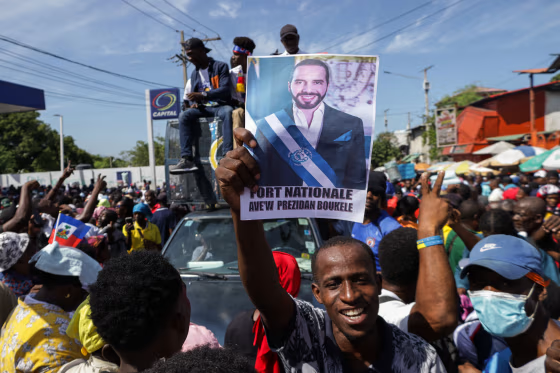
Thousands of people took to the streets of Port‑au‑Prince and surrounding areas on Tuesday, gathering to applaud El Salvador’s president, Nayib Bukele, and the Salvadoran soldiers who are battling gangs in Haiti.
Many demonstrators held placards urging Bukele not to abandon the effort. One read, “Keep fighting … because otherwise they’ll end up killing us all.” Others shouted, “Give them the drones and the dogs!” – a reference to the explosive drones that have been used against gang‑held neighborhoods and the newly deployed robot dogs that have been seen patrolling the capital.
Bukele sent roughly 2,500 troops to Haiti last month after four of his own men were attacked on 18 October and have remained missing. Since that deployment, clashes between Haitian security forces, foreign troops and the gangs have intensified. Haiti continues to be engulfed in violence, with more than 20,000 deaths recorded over the past five years and gangs estimated to control about 70 % of Port‑au‑Prince.
Among those marching was Maxseau Lomba, who said, “The gangs drove us out, burned our homes and killed our children. They even murdered pregnant women. We have lost everything. We thank you, our father, Bukele.”
Marie Michelle Dorville, a 55‑year‑old street vendor, also joined the protest. She recounted that her partner was killed by gang members, leaving her to raise three children alone. “Bukele gives us a glimmer of hope,” she said, urging him and the police to eliminate the gangs “once and for all so everyone can live a normal life.”
Sam Vigersky, a fellow at the Council on Foreign Relations, wrote in a report released Tuesday that the Haitian enthusiasm for Bukele is understandable. “El Salvador’s deployment of more troops in two weeks than the U.N.–backed mission managed in an entire year has sparked a long‑dormant sense of hope among many Haitians,” he wrote.
Police used tear‑gas in the afternoon to disperse the crowd as it moved toward a stadium that Haitian and foreign forces recently secured. The venue had been under gang control for more than two years, preventing Haiti from hosting its World Cup qualifying matches at home.
While chants of “Bukele!” echo across the country, analysts caution that there is no durable plan for maintaining security once the Central American troops withdraw. Diego Da Rin, an analyst with the International Crisis Group (ICG), warned that today’s enthusiasm could quickly turn into anger toward the government if the Salvadoran forces leave.
The ICG released a report on Tuesday, based on more than 100 interviews with officials in Haiti and abroad, that highlights a series of governmental failures and missteps. The study urges Haitian leaders to devise a strategy that will prevent the nation from collapsing after international forces depart. “The new foreign mission offers only temporary relief from gang violence; its aim is to weaken, not dismantle, the criminal groups,” the report states. “Haiti must begin preparing now for the day when its own security forces are once again called upon to assume full responsibility.”
Current anti‑gang actors include Haiti’s police and army, a U.N.–backed gang‑suppression unit, self‑appointed vigilantes, the private security firm Vectus Global – founded by former U.S. Navy SEAL and Blackwater founder Erik Prince – and the roughly 2,500 Salvadoran troops, who are operating largely on their own after four of their own were lost in a deep‑gang‑controlled area.
The ICG warns that Haitian authorities lack a coherent strategy for threat identification, coordination and long‑term violence reduction. A recent cartoon in the newspaper Le Nouvelliste illustrated Haitians cheering Bukele while standing beside a table bearing a crayon‑drawn “PLAN ANTI GANG.”
The report notes that a proposal to create a National Security Council two years ago, intended to craft a long‑range security plan, never materialised. Interviews with former senior officials revealed concerns that such a council could oversee intelligence gathering – a tool previously used by Haitian leaders to target political opponents – and that top officials were reluctant to redirect intelligence funds for fear of losing that revenue.
A foreign adviser cited in the study said the absence of a national strategy forces different police units to follow disparate operational guidelines, often dictated by their foreign donors. As of last year, Haiti’s National Police numbered no more than 8,000 active officers for a population of nearly 12 million. Many of those officers hold command or administrative posts and rarely see street patrols, while others lack combat training.
To boost numbers quickly, police training was cut from seven months to under four months. Promotions are rarely based on seniority or merit; some rank‑and‑file officers have been known to collaborate with gangs, join private security firms or engage in arms trafficking to supplement their modest earnings. Lower‑ranked police receive roughly $300 a month before mandatory deductions.
The ICG calls for higher salaries, better benefits and facilities for police, as well as specialized training and a transparent promotion system grounded in performance rather than political patronage.
The death toll is expected to rise as foreign forces increasingly rely on helicopters and explosive drones – capabilities that Haitian security forces do not possess. The United Nations reports that at least 87 civilians, including 21 children, were killed by drone strikes between July 2025 and September 2026.
Vigersky adds that humanitarian conditions are deteriorating: 5.8 million Haitians now face acute hunger and 1.5 million are displaced, both record figures. The International Crisis Group notes that in the first quarter of 2026, civilian casualties caused by security forces rose 24 % as a share of total casualties, a trend it expects to continue.
According to the ICG, the use of drones and similar weapons has yielded diminishing returns, failing to produce significant changes in territorial control or the overall balance of power. Nonetheless, the report says an outright ban on drones is unrealistic at this stage.
This week, Haitian Justice Minister Patrick Pélissier travelled to El Salvador for an international conference and is slated to meet with Salvadoran officials. Salvadoran Vice President Félix Ulloa said on Monday that the bilateral agreement with Haiti will not be made public, suggesting that critics are trying to undermine the operation. He added that the deal does not guarantee respect for human rights or the rule of law.
Ulloa and Salvadoran Security Minister Gustavo Villatoro said the Salvadoran soldiers will return home as soon as the four missing aviation technicians are located. “We must start preparing Haiti for genuine rule of law, so that its institutions function and its legal frameworks operate effectively in the future,” Villatoro said.