
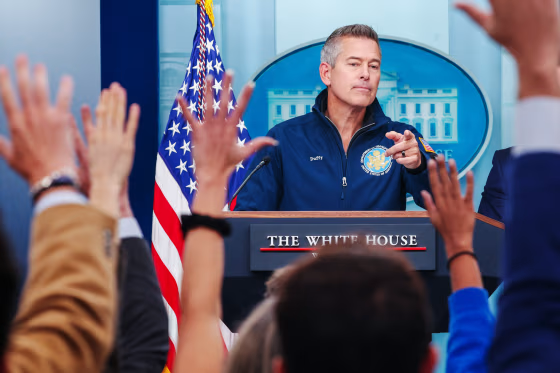
WASHINGTON — The Trump administration has asked Congress for an additional $50.1 billion for the Federal Aviation Administration after a nationwide ground stop on Friday halted thousands of flights and left passengers stranded. The request, which was raised from an earlier $30 billion figure, was delivered in a letter on Tuesday signed by Transportation Secretary Sean Duffy, who placed the blame for the outage on his predecessors and on Congress rather than accepting responsibility. The letter, also signed by FAA chief Bryan Bedford and White House budget director Russell Vought, said the money was needed “to deliver a truly world‑class air traffic control network.”
Following a public rebuke of Congress last week, Duffy met privately with Senate Republicans on Tuesday to push his case. According to an unnamed source who was present, the briefing turned heated, with several Republican senators raising their voices at the secretary. After the meeting, Senate Republican leaders and Duffy held separate news conferences.
Senate Majority Leader John Thune, R‑South Dakota, stopped short of endorsing the full amount, noting that Republicans agree on the importance of “safe skies” but that the exact dollar figure would have to be worked out. “We’ll see what the traffic can support and what’s realistic,” he said, describing the funding level as a matter for further discussion.
Duffy’s meeting on Tuesday was limited to Republicans, even though the normal appropriations process requires bipartisan backing. Democrats, meanwhile, have pressed for a clearer explanation, especially after Duffy’s earlier remarks that singled them out. Senate Minority Leader Chuck Schumer, D‑New York, told reporters that the administration had not been forthcoming with answers. “At his first press conference, Duffy only attacked Democrats and asked for $50 billion when the $12 billion we already gave them hasn’t even been spent. I have little confidence in their approach,” Schumer said.
When pressed about the $12.5 billion already allocated for air‑traffic‑control upgrades, Duffy argued that the sum was insufficient for the specific improvements needed after the recent disruption. Some Democrats expressed frustration with the size of the new request. “I generally support investing in air traffic control, but $50 billion sounds like an oddly round number,” said Senator Brian Schatz, D‑Hawaii, who sits on the Senate Appropriations Committee and is expected to become the majority whip.
The funding debate is occurring against the backdrop of broader negotiations to keep the government running past the Dec. 11 deadline. Lawmakers could reach a full‑year funding agreement, pass a short‑term stopgap, or risk a shutdown. Republican Senator Bernie Moreno, R‑Ohio, called air‑traffic‑control financing “absolutely not a partisan issue” and said Congress would ensure any money is provided responsibly.
Republicans are also weighing a partisan “reconciliation” measure to approve defense spending without Democratic votes; Democrats have signaled they would likely oppose additional military funding unless the conflict in Iran ends. If such a bill were to move forward before the GOP loses its majority, it would need a budget resolution by Thanksgiving and near‑total Republican unity in both chambers, a process that would be lengthy and complex.
When NBC News asked why he had only met with Republicans, Duffy said he had spoken with Democrats by phone and that he was not trying to dictate their work. “I’ve spent hours on the phone with Democrats. They understand the issue. I’m making a straightforward request and will let them follow their own process,” he told reporters after his meeting with GOP senators.
One Democratic official Duffy spoke with was House Minority Leader Hakeem Jeffries, D‑New York, who is expected to become the next speaker of the House. Jeffries said he appreciated the conversation but still had many unanswered questions about the ground stop and how to prevent a recurrence. “These incidents are concerning, and it’s not clear whether they stem from infrastructure problems or something more malicious,” he said, requesting a briefing on the recent FAA outages.
Outgoing House Speaker Mike Johnson, R‑Louisiana, said Republicans would work with the administration to fund “as much of that as we can,” referencing the $12.5 billion already approved for FAA modernization. He did not give a timeline or indicate whether Congress would pursue a supplemental appropriations package.