
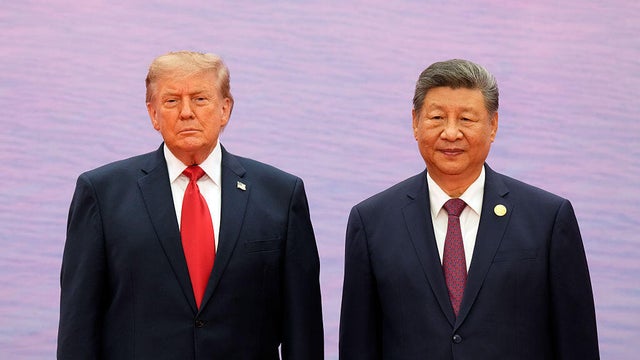
President Donald Trump is meeting Chinese President Xi Jinping on Thursday in Shenzhen, China, as part of the Asia‑Pacific Economic Cooperation (APEC) summit. The two leaders have now faced each other three times this year: they last met in September at the White House for a three‑day summit, and Trump will host Xi again at the G20 leaders’ gathering at Trump National Doral in Miami this December. After the bilateral talks, a three‑way meeting with Russian President Vladimir Putin is scheduled.
Trump hinted that he may raise the case of Alice Huang, a former Megaspeed executive who has been accused of spying for China and of having an affair with Nvidia co‑founder Jensen Huang. The Justice Department is probing Singapore‑based Megaspeed for allegedly diverting advanced semiconductor chips to China. When asked about the allegations, Trump said he was not convinced Huang was an intelligence asset. “I don’t know that she is a spy,” he told reporters. “Usually, when a beautiful woman from China shows up, people call her a spy. I really don’t think that’s the case.”
Chris McGuire, a senior fellow on China and emerging technologies at the Council on Foreign Relations, said the controversy extends far beyond any personal scandal. He told reporters that the core issue is how many chips have reached China, how porous U.S. export controls have been, and how effectively the Commerce Department has enforced those rules. “Those are the longer‑term strategic questions for the United States and the U.S.–China relationship,” McGuire said.
Just before Trump left for Asia, his administration rolled out interim trade measures that bar Chinese artificial‑intelligence firms from remotely accessing the most advanced U.S. chips housed in overseas data centers. The move followed Treasury Secretary Scott Bessent’s criticism of Commerce Secretary Howard Lutnick for allegedly dragging his feet on restrictions targeting Megaspeed. Bessent told CNBC that Trump had signaled China should be cut off from the chips, while Lutnick was resisting. Trump declined to side with either official, noting that the two men “have two different views—one wants to be friendly with China, the other wants to take a hard line.” He added that both perspectives could be judged right or wrong.
Although the Commerce Department issued the rule, the Treasury Department and the National Security Council drafted it. McGuire called the action “very significant,” saying it blocks many of the pathways China has used to obtain AI computing power. He cited a recent digital‑forensic study that found every advanced Chinese model had been trained on the most powerful American chips, indicating that previous bans had been only partially effective. The new restrictions, he said, could “materially widen the lead” the United States enjoys in AI.
Trump has shown no intention of slowing U.S. AI development. After the September summit, both governments agreed to set up a channel for sharing information when artificial‑intelligence systems behave unpredictably. Alvin Wang Graylin, a senior fellow on technology at the Asia Society Policy Institute and a digital fellow at Stanford’s Institute for Human‑Centered AI, warned that post‑incident talks are insufficient. He said he hopes the Trump‑Xi dialogue can move past the current scandal and lead to deeper cooperation on AI safety, including the creation of lasting institutions and more technical‑level exchanges.
When asked whether he would bring up Taiwan, Trump replied, “I’m sure he’ll raise it. I won’t have to raise it.” David Sacks, a senior fellow for Asia studies at the Council on Foreign Relations (not the former White House AI czar), agreed that Taiwan is a routine topic whenever the two leaders meet. He noted that Xi typically uses the meetings to convey his concerns and expectations about cross‑strait dynamics. A $14 billion arms package for Taiwan remains on Trump’s desk; the Navy had paused the sale earlier this year to preserve ammunition for the war in Iran, but Sacks said congressional pressure is likely to mount in the coming months. He added that Xi may try to persuade Trump to approve the deal, which would “send cross‑strait relations reeling.”
Lyle Goldstein, director of Defense Priorities Asia, expressed optimism about the three‑way summit with Putin. While he does not expect any breakthrough agreements, he believes the historic trilateral format could lay groundwork for future U.S.–China–Russia discussions. “It could allow for some movement on major issues,” Goldstein told CBS News.
Trump said the agenda with Xi and Putin will also cover denuclearization, noting the difficulty of any nation agreeing to give up nuclear weapons. He added that Iran will be discussed, warning that Tehran would face severe consequences if it attempted to detonate a “dirty bomb,” a claim that followed a CNN report citing U.S. intelligence on Iranian plans. Although the White House had previously said Ukraine would not be on the table because no Ukrainian officials would be present, Trump later confirmed that the conflict will be a topic of conversation. “We’ll talk about my favorite subject, Ukraine,” he told reporters.