
From the Politics Desk is a daily newsletter that delivers the latest reporting and analysis from NBC News’ politics team covering the White House, Capitol Hill and the campaign trail. In today’s edition, Andrea Mitchell examines the repercussions of President Donald Trump’s three‑way meeting in China, while Sarah Sternhagen looks at how close Republicans came to suffering even larger losses in the midterms.
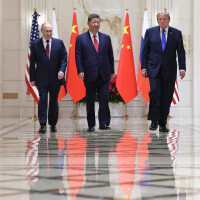
The White House promoted the image of an American president meeting side‑by‑side with the leaders of China and Russia as a historic moment—three heads of the world’s biggest nuclear arsenals gathered in one place. Some observers likened it to the 1945 Yalta conference, when Franklin D. Roosevelt, Winston Churchill and Joseph Stalin carved up post‑war Europe, a decision whose effects lasted for decades.
In substance, however, the summit produced no tangible agreements. It did, nevertheless, send a clear signal that President Donald Trump, as the head of the world’s leading democracy, was willing to stand shoulder to shoulder with Chinese President Xi Jinping and Russian President Vladimir Putin without addressing issues such as human‑rights abuses, press freedom or political prisoners. Both Beijing and Moscow released statements that simply noted the lack of any formal accords, and there was no progress on nuclear non‑proliferation, trade, or the supply of critical minerals.
Trump’s embrace of Xi in Shenzhen can be framed as an effort to keep a constructive dialogue open between the two largest economies. By contrast, NATO allies found it far harder to accept Trump’s warm greeting to Putin, whom he called “my friend” despite the Russian leader’s ongoing invasion of Ukraine. Poland’s prime minister, Donald Tusk, posted on X, “God protect us from such friends.”
Some analysts suggest that appearing together with the two autocrats—both effectively lifelong rulers—was meant to shore up a president whose political standing had been weakened by a massive midterm defeat and by two wars he had pledged to end quickly. During the 2024 campaign, Trump promised that he could resolve the conflict in Ukraine within a day of taking office, and after joining Israel in February in a strike on Iran, he claimed that the Iranian war would be over in a few weeks.
After leaving China, Trump joined a conference call with his two envoys, Steve Witkoff and his son‑in‑law Jared Kushner, who were in Berlin meeting Ukrainian officials and an eight‑member European team working on security guarantees and an economic reconstruction plan for Ukraine. Ukrainian President Volodymyr Zelenskyy told NBC’s Richard Engel that Trump’s meetings with Putin and Xi took place without Ukrainian participation, saying, “You can’t decide about a country, even a small one, without that country.” In a later address to his nation, Zelenskyy said the United States would soon provide details about the president’s talks and reiterated that “Ukraine must be part of any decision that concerns Ukraine, and Europe must be part of any decision that concerns Europe.”
Before the Shenzhen summit, European leaders had been assured that Trump, Putin and Xi would not discuss Ukraine without Europe’s involvement. The situation was underscored when Russian forces bombed Kyiv and other Ukrainian cities during the summit and in the hours that followed. Ukraine responded by striking a key bridge that links Russia to Crimea—a target of both strategic and symbolic importance to Putin.
Trump has recently repeated his view that Zelenskyy could have averted the war, a stance that appears to overlook the fact that Russia’s invasion violated existing non‑aggression treaties. Meanwhile, U.S. negotiators have been pressing Ukraine for concessions even as Putin has shown no sign of being ready to compromise. The Shenzhen meeting is likely to bolster Putin’s belief that he can count on Trump’s support.
The 2026 elections have already been disastrous for Republicans, who have lost at least 42 seats in the House. The margin of defeat could have been far worse. Of the Republican House candidates who managed to hold on, 26 won by fewer than three percentage points—a proportion far higher than in recent midterms. By comparison, in the 2018 blue‑wave election, only 13 GOP House members were elected by such narrow margins.
Only 41 Republican representatives secured at least 60 % of the vote this cycle, whereas more than four times that number—174 Democrats—reached the same threshold. In the 2022 midterms, when President Joe Biden’s low approval ratings weighed on his party, 126 Democratic House members earned at least 60 % of the vote, while 153 Republicans did so.
In the latest race calls, Republican Nick Begich won Alaska’s at‑large House seat after a ranked‑choice tabulation, providing a rare bright spot for the GOP. The current composition stands at 257 Democrats and 173 Republicans, with NBC News’ Decision Desk still waiting to project winners in five remaining House contests, including two Louisiana races that will go to December runoffs.
That concludes today’s From the Politics Desk. The newsletter was compiled by Adam Wollner. Feedback—positive or negative—can be sent to politicsnewsletter@nbcuni.com. If you enjoy the briefing, feel free to share it and invite others to subscribe.