
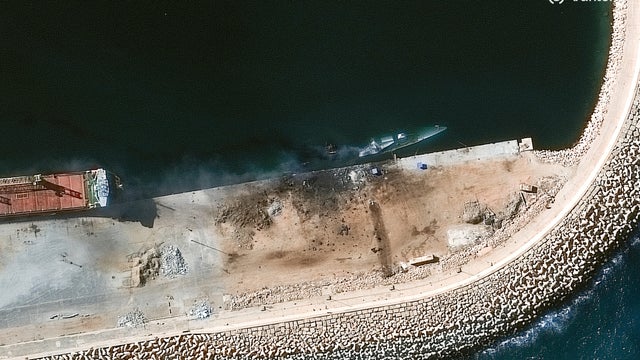
Kyiv – Ukrainian President Volodymyr Zelenskyy said on Monday that Ukraine was responsible for an attack on a Russian warship off the coast of Libya on Sunday, claiming that a squadron of home‑grown naval drones sank the vessel. He posted on social media that seven Ukrainian drones were used to bring down a Russian corvette, which he described as one of the newest ships commissioned in 2023 during Russia’s invasion of Ukraine.
“Despite all the enemy’s attempts to thwart the strike, the Russian corvette Merkury was sunk,” Zelenskyy wrote. He also said a Russian Ka‑27 military helicopter was destroyed in the same operation. “We keep operating in the waters we have designated. We are answering Russia’s aggression and advancing Ukrainian weapons,” he added.
The president also said Ukrainian forces hit the Russian dry‑cargo ship MV Angara off Libya on Sunday, alleging that Moscow used the vessel to move weapons. The Angara is subject to U.S. and broader international sanctions for illicit arms transport on behalf of Russia.
A separate incident involved the cargo ship Sparta II, operated by the Russian defence‑logistics firm Oboronlogistika, which was struck by drones on Saturday in the Gulf of Finland. The attack sparked a fire aboard the vessel. While Kyiv has neither confirmed nor denied involvement, Finland’s armed forces said the strike was probably Ukrainian. The Sparta II is also listed under U.S. sanctions for illegal shipment of military equipment. Russian, Estonian and Finnish ships helped extinguish the blaze and rescue the crew, and a Russian vessel began towing the damaged ship on Sunday, according to Reuters.
Zelenskyy thanked the Security Service of Ukraine (SBU) and other Ukrainian defence units that participated in the Libyan strikes, calling the operation “an exemplary Ukrainian response to Russia’s war.” He said he received detailed briefings on Sunday and Monday and that “the targets we set were achieved.”
The Kremlin did not immediately comment on the Libyan attacks, saying only that the Russian defence ministry would later release information about the incidents. Regarding the Gulf of Finland strike, Kremlin spokesman Dmitry Peskov told reporters on Monday that it illustrated “a very dangerous trend – the spread of terrorist activity in the Baltic region… This is very dangerous and inevitably raises tensions in the area.” He added that Russia hoped the Baltic states would use whatever influence they have over Ukraine to warn it against continuing such “dangerous terrorist practices.”
The Libyan operation, carried out roughly 1,500 miles from Ukraine’s front line, represents another long‑range raid by Kyiv’s forces. Ukraine has previously surprised Moscow with inventive attacks, such as the June‑last “Operation Spider’s Web,” in which truck‑launched drones hit more than 40 aircraft on Russian bases.
According to two Libyan officials, the sea‑drone strike caused severe damage to the Russian corvette at the Benghazi naval base in eastern Libya. Residents of Benghazi reported loud explosions and flames at the base early on Sunday, and civil‑defence teams moved in to put out the fire.
Libya has been split since the 2011 NATO‑backed uprising that toppled Muammar Qaddafi. A United Nations‑backed government sits in Tripoli, while a rival administration controls the east. The oil‑rich country remains a focal point for the ongoing rivalry between Russia and the West. The UN Support Mission in Libya (UNSMIL) expressed “serious concern” over the attack and called for “an immediate, independent and transparent investigation,” warning that “Libya cannot afford, and must not become a battleground for foreign conflicts.”
Ukrainian forces are operating in western Libya under a covert arrangement supported by Western partners. Libyan officials said Ukrainian operators, mainly drone specialists, used the country’s territory to strike a Russian tanker in the Mediterranean in March. At that time, most of the Ukrainian personnel were based at an airfield in the coastal city of Misrata, with additional presence in facilities in Tripoli and the town of Zawiya, according to statements to the Associated Press earlier this year.
The SBU described the latest raid as “unique,” noting that the drones were delivered to a pre‑selected launch point and released from a so‑called “mothership” near the target. Russian air, sea and land forces attempted to intercept the drones, the agency said. “Ukraine’s defence forces have once again demonstrated that the Russian navy and its logistics have no safe routes, even far beyond the Black Sea,” the SBU added.
Meanwhile, Russia launched another wave of airstrikes overnight against Ukrainian cities. Regional officials reported that the attacks on Kyiv and the southern Zaporizhzhia region killed 17 people, including one child, and injured dozens more.