
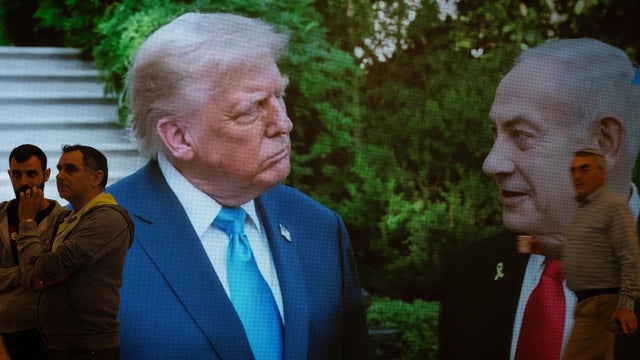
Israel and the United States are reportedly weighing a fresh military strike against Iran in the near term, according to people with direct knowledge of the discussions.
Tel Aviv sources told CBS News that Prime Minister Benjamin Netanyahu’s government is increasingly alarmed by how quickly Tehran is restoring its ballistic‑missile production capacity and by the speed with which it is moving both its conventional and nuclear assets underground to shield them from attack.
President Donald Trump also claimed this week that Iran may be pursuing chemical or biological weapons, though he offered no proof to back the allegation.
Months of indirect talks between Washington and Tehran have not produced a cease‑fire agreement that would reopen the Strait of Hormuz. Iran has refused to even discuss its nuclear program unless the United States lifts the naval blockade and meets six other core demands.
Israel’s armed forces say they are prepared for another round of hostilities with Iran and have placed their defenses on the highest alert in case Tehran initiates an attack.
While Netanyahu’s team would prefer to launch a joint operation with the United States, the sources said it remains uncertain whether Trump wants to order new combat actions, and if so, what form they would take. The war has become a major political liability for Republicans after the recent midterm elections and remains deeply unpopular among the American public.
The United States still has a substantial military presence in the region, including tens of thousands of troops, two aircraft carriers with their accompanying strike groups, and dozens of warships and aircraft.
Both leaders, who together began the current conflict with a massive barrage of strikes against the Islamic Republic almost nine months ago, may be seeing the window for coordinated action narrow. Netanyahu could lose his premiership in the coming weeks after Israel’s national election held late last month, and Trump’s Republican Party is set to lose control of both chambers of Congress in January, giving his opponents greater influence over war funding.
Neither Netanyahu’s office nor the Israeli military responded to requests for comment on plans for a possible third major round of attacks on Iran. The White House and the U.S. military also declined to speak, although senior American commanders have long said they stand ready to carry out any orders Trump might issue. With forces already positioned, a new offensive could be launched within two to four days if an order were given.
Trump has repeatedly said that Iran wants a deal to end the war, but Tehran has rejected any cease‑fire to reopen the Hormuz Strait or any nuclear talks unless the United States accedes to seven key demands, including an end to all hostilities in the Middle East and a lift of the blockade on Iranian ports and vessels.
In addition to concerns about Iran’s expanding conventional‑weapon capabilities—a point the regime itself has boasted about—Trump raised the possibility that Tehran is seeking biological or chemical weapons. “They’re looking at gases, looking at bio, because we’ve shut them out with the nuclear,” he told a Fox News reporter in China before meeting Russian and Chinese leaders.
Iran’s foreign ministry dismissed the accusations on Thursday, likening them to the U.S. claims that Iraq possessed weapons of mass destruction before the 2003 invasion. Spokesperson Esmaeil Baqaei wrote on X: “We find ourselves facing ominous new allegations and a narrative that appears to be following the same fraudulent script.”
Trump has not offered a clear indication of whether he intends to order a major new military move against Iran. On Wednesday he told Fox News that he still wants a durable agreement with Tehran, while also renewing his threat to use force: “I’m going to finish it off… yeah, soon. I mean, one way or the other, we’ll finish it off.”
The following day, speaking to Israel’s Channel 12, he said he was “not rushing into any decision,” suggesting he might allow the stalemate to persist into 2027. “We will see what happens after the beginning of the year,” he added.
U.S. Central Command head Admiral Brad Cooper, who oversees American forces in the Middle East, met on Wednesday with senior Israeli security officials at Israel’s defense ministry for what the Israeli military described as a “joint, comprehensive situational assessment.” Attendees included Israel’s top general, Eyal Zamir, and Mossad director Roman Gofman. The presence of the Mossad chief—who rarely travels abroad—was seen by many in Israel as evidence that Iran was a central topic of the talks.
Gofman had met U.S. officials in Washington the previous week, including CIA Director John Ratcliffe, according to people familiar with the meetings. “The head of the Mossad, who hardly leaves the country, didn’t go for a brief in‑and‑out, but for a couple of days. It’s a serious matter on the table,” said Erez Winner, chairman of the Israel Defense and Security Forum, a think‑tank close to Netanyahu’s camp.
If a decision is taken to re‑engage Israel in war with Iran, it would come at a politically delicate moment for Netanyahu. His rivals, tasked with forming a government after last month’s election, could see him out of office within weeks, if not sooner. Since losing his parliamentary majority, Netanyahu has argued that a unity government is essential to confront the nation’s pressing security threats, repeatedly accusing Iran of seeking a nuclear weapon.
Iran denies any intention to build a nuclear bomb, but after Trump withdrew the United States from the 2015 nuclear accord, Tehran accelerated uranium enrichment well beyond civilian needs. International monitors estimate that Iran now holds roughly 900 pounds of uranium enriched to 60 percent, a level only a short technical step away from weapons‑grade material.
Some of Netanyahu’s political opponents suspect he may be pushing for renewed conflict to preserve his own power. In recent days he has held security briefings with several of those rivals—an unusual move that analysts say could signal imminent military action.
Trump endorsed Netanyahu ahead of the Israeli election and said he would prefer to partner with the right‑wing Israeli leader if a new strike on Iran were contemplated.
The speculation about a major new operation comes amid a fresh exchange of fire between the United States and Iran. On Tuesday the United States struck Iran’s strategic Qeshm Island in the Strait of Hormuz, describing the raid as self‑defense after Iranian attacks on U.S. assets in Bahrain that were reportedly intercepted. Iran also launched missiles at Kuwait this week, which officials said caused no damage.
Iran’s leadership has been publicly preparing for a possible escalation and warned that any retaliation would be broader than previous strikes. Senior figures in the Islamic Revolutionary Guard Corps have threatened to expand attacks to U.S. bases in Europe, Gulf energy facilities and undersea internet cables.
A statement attributed to Supreme Leader Ayatollah Mojtaba Khamenei warned that, should open hostilities resume, “there would be no geographical limit for Iranian missiles.”