
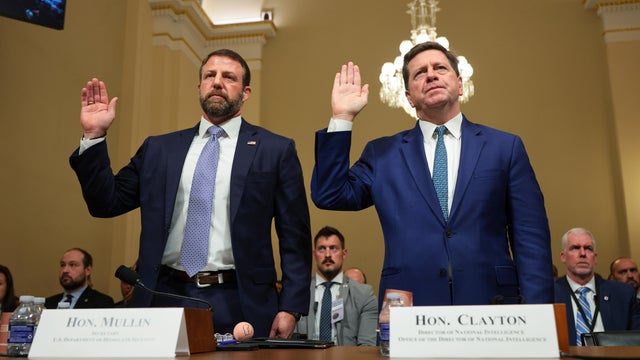
Washington — Senior U.S. national‑security officials told members of Congress that they have found no evidence linking a series of recent technology outages — which affected airlines, banks, Microsoft services and national‑security communications systems — to coordinated or malicious cyberattacks. Lawmakers, however, continued to press for clarification about a recent outage at the National Security Agency and about reports of possible Iranian plots on U.S. soil.
During a Wednesday hearing of the House Homeland Security Committee, Homeland Security Secretary Markwayne Mullin, Director of National Intelligence Jay Clayton and FBI Deputy Director Christopher Raia tried to assure legislators that federal agencies are actively investigating the disruptions and monitoring any potential threats.
“We have seen nothing that would indicate that they are related,” Mullin said, adding that the Department of Homeland Security has been in contact with private‑sector partners while reviewing the incidents.
Clayton echoed that assessment, saying intelligence officials reached the same conclusion after consulting with other government agencies and cybersecurity experts from industry.
“These are separate service outages tied to maintenance and technical changes. They are not a coordinated or state‑sponsored attack,” he said.
Raia noted that FBI cyber specialists have been involved in examining the events from the outset.
“At this point, there is no indication whatsoever of any malicious cyber activity related to any of those incidents,” he said, adding that the bureau will continue to work with private‑sector partners “in an abundance of caution.”
New York Democrat Rep. Dan Goldman challenged Clayton’s description of the recent NSA outage, repeatedly asking whether the disruption stemmed from internal software updates or other routine technical work.
“It’s your testimony today that the technological problems the NSA faced on Monday were from internal software and technological upgrades,” Goldman said.
Clayton replied that officials have found no evidence of outside interference.
“We have no indication that they have come from external threat actors,” he said.
Goldman pressed for a clearer answer.
“It’s a pretty binary. It’s either external or internal, right?” he asked.
Clayton described routine maintenance procedures — such as software patches, system upgrades and hardware replacement — that can require systems to be taken offline and rebooted.
Goldman accused Clayton of evading the question.
“You’re a very smart person, and you’re clearly not answering my direct questions,” he replied.
Separately, Clayton warned that rapid advances in computing power and increasingly sophisticated software are putting new pressure on older government technology.
“The speed of compute and the level of capability of applications that use that compute is increasing substantially,” he said, noting that legacy systems can become obsolete much faster than before, with infrastructure deemed outdated only months ago now falling further behind as technology progresses.
Mullin has already faced criticism for taking a government aircraft to a college‑football game the day after an FAA ground stop, while airports across the country remained chaotic. He defended the trip, saying he would have shown “distrust” in the nation’s airspace if he had not flown.
Lawmakers also raised concerns about reports that Iranian‑linked actors might be developing plans to target senior Trump‑administration officials with a radiological device, commonly called a dirty bomb, or with chemical weapons.
Mississippi Republican Rep. Michael Guest asked whether federal authorities are prepared to detect and disrupt possible Iranian sleeper cells operating in the United States.
“Are we concerned about the possibility of sleeper cells?” Guest asked Mullin.
“Is it a concern? Of course. Are we fighting it and stomping it down every single day? Absolutely,” Mullin replied, adding that DHS personnel are working closely with intelligence and Justice Department officials to identify threats and prevent attacks.
Clayton also highlighted the danger of online radicalization, explaining how foreign extremist networks can influence individuals already living in the United States.
“That’s not theoretical; it’s real. We saw it in New York. We’ve seen it in other cases,” he said.
Raia cautioned that intelligence reports about possible plots do not necessarily mean the attackers have the capability to carry them out.
“A lot of the reporting is largely aspirational,” he said. “But that does not mean we do not take it seriously.”
He said authorities have revamped the Iranian threat mission center to strengthen efforts against potential attacks, referencing earlier investigations into plots targeting dissidents.
The officials did not confirm publicly that Iranian sleeper cells are actively preparing attacks on U.S. soil, nor that the alleged dirty‑bomb or chemical‑weapon plans are operational.
Clayton said Iranian threats both inside and outside the United States have “dramatically increased.”
“We remain committed to detecting, deterring and combatting the Iranian lethal plotting outside the United States and inside the United States,” he said. “These threats have dramatically increased.”