
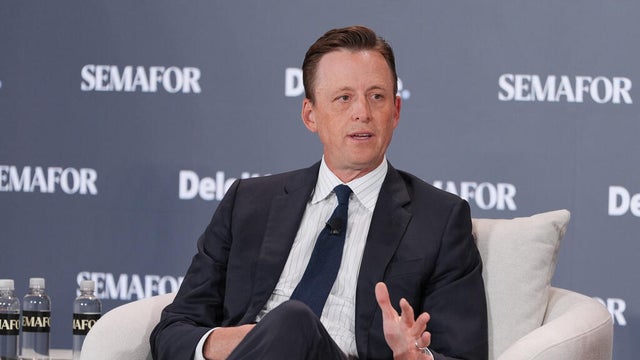
White House officials have told CBS News that Sean Cairncross will be departing his post as the nation’s cyber director. Multiple sources said the departure is the result of a termination.
According to those same sources, White House chief of staff Stephen Miller—who succeeded Susie Wiles earlier this month—had long been dissatisfied with Cairncross, questioning whether he possessed the technical expertise required for the role. Miller promptly set in motion a search for a successor, and the administration is expected to name Pentagon chief information officer Kirsten Davies as the next national cyber director. Axios was the first outlet to break the news of Cairncross’s exit.
Cairncross’s resignation comes at a time when the United States is grappling with a spate of technology failures that have disrupted Microsoft services, air‑traffic‑control systems, banking operations and even the internal network of the National Security Agency over the past week. Homeland Security Secretary Markwayne Mullin told congressional committees that investigators have found no indication the outages are linked, expressing 98 percent confidence that they are not the product of hostile foreign actors, while acknowledging the sheer volume of incidents is unprecedented.
The national cyber director, a position confirmed by the Senate, serves as the president’s principal adviser on cybersecurity and oversees the coordination of cyber policy across federal agencies. An attorney by training, Cairncross has held the post since August 2025. The role was created in 2021, and in recent years the United States has faced a series of cyber intrusions attributed to actors in Iran, Russia, China and other adversarial nations.
In March, the Trump administration released a seven‑page cyber strategy that Cairncross’s office helped craft. The document pledged to “detect, confront, and defeat cyber adversaries before they breach our networks and systems,” to harden critical infrastructure, preserve America’s lead in artificial intelligence and modernize federal technology systems.
Speaking at the Aspen Cyber Summit in November 2025, Cairncross said the administration’s chief aim was to impose “costs and consequences” on hostile actors. “I think, as a country, we have not done a terrific job of sending a signal to our adversaries that this behavior is not consequence‑free,” he remarked, adding that the threat landscape is expanding and becoming more aggressive each day.
If the Trump administration wishes to appoint another permanent cyber director, it faces a narrow window before the Senate shifts to Democratic control in January.
In a statement, Cairncross described the position as “the honor of a lifetime.” He said he leaves “incredibly proud of our work to strengthen America’s cybersecurity, protect our critical infrastructure, confront foreign threats, and position America to lead the world in Super Intelligence,” and credited “President Trump’s extraordinary leadership” for those achievements.