
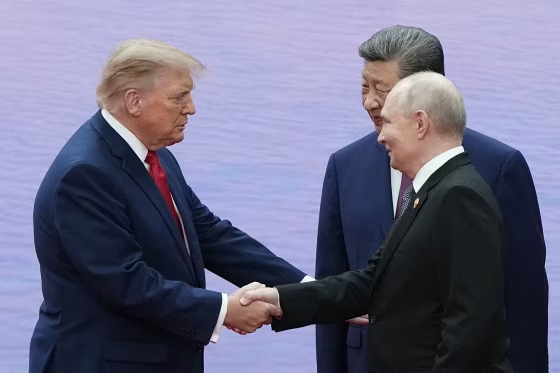
SHENZHEN, China — The decisions that could emerge from a three‑way summit involving President Donald Trump, President Xi Jinping and President Vladimir Putin may have worldwide implications, even before any statements are made in English, Russian or Mandarin. Observers have already likened the gathering to the 1945 Yalta Conference, where Franklin D. Roosevelt, Winston Churchill and Joseph Stalin divided the post‑war order.
The three leaders are set to meet on Thursday on the margins of the Asia‑Pacific Economic Cooperation summit in Shenzhen, the Chinese city known for its technology sector. Their presence underscores a shift in global power dynamics: Trump heads the world’s largest economy, Putin controls the biggest nuclear arsenal, and Xi presides over the largest standing army and manufacturing base. Allies whose security depends on the outcomes of such talks may feel uneasy, recalling the adage that those not at the table become the menu.
The gathering marks a departure from the United States’ post‑Cold‑War strategy of keeping Moscow and Beijing apart, according to Ali Wyne, senior adviser on U.S.–China affairs at the International Crisis Group in Belgium. Wyne said the current overture appears to be Trump and Putin seeking favor with Xi, adding that the visual impact of the trio will be striking.
Trump has said he wants to cover nuclear arms control, the conflict in Iran, trade and economic issues, and on Monday he singled out Ukraine as his “favorite subject,” a stance that runs counter to recent White House statements that the war in Ukraine would not be on the agenda. He has previously advocated for a fresh nuclear‑arms agreement that would bring China into the fold, after the New START treaty between Washington and Moscow expired in February.
John B. Emerson, who served as U.S. ambassador to Germany under President Obama, noted that when the heads of the three biggest nuclear powers convene to discuss curbing proliferation, the meeting carries inherent significance. Craig Singleton, a China specialist at the Washington‑based Foundation for Defense of Democracies, said Trump views a denuclearization deal as a hallmark of his legacy and is betting that his personal contacts can assemble a summit that previous presidents could not.
Singleton added that the most notable achievement would be persuading Beijing to engage in genuine nuclear‑reduction talks, though he described that outcome as unlikely. China’s own nuclear stockpile, estimated at about 600 warheads and expanding quickly, still lags far behind the roughly 5,000 held by each of the United States and Russia.
Moscow has signaled that it wants Ukraine on the discussion list, albeit not as a participant. This comes as both U.S. and Russian officials have called for broader negotiations on Europe’s security architecture as part of any lasting settlement—an idea that unsettles long‑standing American allies. Ukrainian President Volodymyr Zelenskyy warned last month that he does not want a repeat of Yalta, fearing a new division of influence.
U.S. officials briefed the press before Trump’s trip, emphasizing that the Ukraine war would be handled on a separate track that does not involve China, and that it would be inappropriate for the three heads of state to raise the issue directly. Beijing has also indicated it would not discuss Ukraine without European leaders present.
Even if the three presidents avoid any concrete decision on Ukraine, the very fact of the meeting fuels Kyiv’s suspicion that Washington may be negotiating with Moscow to Kyiv’s disadvantage, or even aligning with Moscow, Wyne said.
China has described the trilateral encounter as having “groundbreaking significance,” yet it has also cautioned against inflated expectations. Da Wei, who directs the Center for International Security and Strategy at Tsinghua University, said he does not anticipate immediate tangible results but views the summit as a starting point that could help stabilize international relations. He remarked that regardless of personal opinions, the three leaders and their nations are pivotal architects of the global order, making their dialogue a positive development.
The report was filed by Jennifer Jett and Janis Mackey Frayer from Shenzhen, with additional coverage by Alexander Smith from London.