
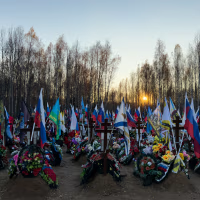
More than 700,000 Russian servicemen are believed to have died in the war in Ukraine, according to a new projection that draws on leaked official statistics. The figure highlights the enormous human cost of President Vladimir Putin’s campaign, now in its fifth year.
The estimate is based on a cache of data from Rosstat, Russia’s state statistics agency, that was obtained by Belarusian and Ukrainian hackers earlier this month. The files show that, as of the end of September, at least 490,000 Russian soldiers had been recorded as dead. Independent outlets such as the BBC and other media have reported the same number after analysing the leak. An exiled Russian news site, Meduza, used the same mortality data to extrapolate a total death toll that includes unregistered cases, arriving at a figure of roughly 720,000.
NBC News did not have direct access to the leaked files and could not independently verify the numbers. Neither the Russian nor the Ukrainian governments publish regular casualty figures.
For years, the independent outlet Mediazona, together with the BBC Russian Service and a network of volunteers, has been assembling a named list of Russian war dead from open‑source material, because official numbers are scarce. Mediazona says it extracted 29.7 million death‑registration records covering almost all deaths in Russia from early 2021 through September 2024. The list focuses on entries that specify a military cause of death or are linked to court rulings that declare a person dead.
When Mediazona compared the leaked Rosstat data with its own named list, the two matched on about 95 percent of the entries. The figures also aligned with the publicly available national Probate Registry, which tracks inheritance cases, and with Rosstat’s own mortality statistics. To guard against fabricated entries, Mediazona cross‑checked each record’s unique vital‑record number and the corresponding court rulings, concluding that the dataset is authentic and that fabricating a collection of this size would be “impossible.”
The hackers shared the data with several other exile‑based Russian media outlets and with the BBC, all of which arrived at a death count close to the 490,000 figure reported by Mediazona. A senior British defence official gave a similar estimate of about half a million Russian troops killed in September.
Before this new analysis, Mediazona and the BBC’s publicly available database of Russian war casualties listed just over 289,000 names, compiled from obituaries, local news reports and official registries. The Russian Defence Ministry has not updated its own casualty figures since the early months of the conflict, when then‑Defence Minister Sergei Shoigu said the death toll was just under 6,000.
Mediazona cautions that the Rosstat records likely lag behind actual battlefield losses, noting that deaths occurring in 2025 may not yet be reflected in the data. “The leaked records through late September—however reliable they are—still fall short of the true toll,” the outlet said.
Because of this lag, Meduza applied epidemiological techniques and the actuarial “chain‑ladder” method to estimate how many military deaths have occurred but have not yet been recorded. Using those models, Meduza projected a total of about 720,000 Russian fatalities to date, arguing that excluding the unregistered cases would give an incomplete picture.
The Kremlin rejected the analysis on Wednesday. Spokesman Dmitry Peskov told NBC News that only the Ministry of Defence is authorised to release official casualty figures and suggested that any other numbers be ignored.
Assessing Ukrainian losses is equally difficult. President Volodymyr Zelenskyy has occasionally offered estimates, most recently in July, when he said roughly 50,000 Ukrainian soldiers had been killed. Analysts believe that figure is an undercount. A study by the Washington‑based Center for Strategic and International Studies earlier this year put the Ukrainian death toll at up to 150,000, drawing on British military estimates, Mediazona’s named list, the centre’s own calculations and interviews with officials from the United States, Europe, Ukraine and other governments.