
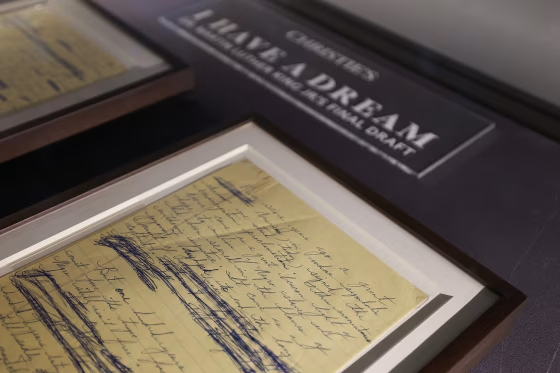
ATLANTA — A page of blue‑ink notes, some crossed out, offers a rare glimpse into the drafting process of the Rev. Martin Luther King Jr.’s most celebrated address.
The speech, delivered on Aug. 28, 1963, from the Lincoln Memorial steps, examined the painful history of slavery, segregation and racism while envisioning a future of equality for Black Americans.
A handwritten version of that address is on view this week in King’s native city before it is put up for sale in a January auction.
“It reveals a genius at work; these words didn’t just flow perfectly onto the page,” said Jill Savitt, president and CEO of the National Center for Civil and Human Rights in Atlanta, where the manuscript will be exhibited through Sunday.
The most famous refrain, “I have a dream,” does not appear in the draft. King added that line spontaneously while standing before a massive crowd on the National Mall during the March on Washington. “Watching the footage, it’s as if a jolt of electricity hits him and he launches into the ‘I have a dream’ segment on the spot,” Savitt explained.
Other pivotal passages, under the heading “Normalcy — Never Again,” are present in King’s own hand, including the opening sentences and the concluding verses that echo an African‑American spiritual.
The seven‑page excerpt, written on yellow, ruled paper, is displayed in two glass cases within the museum’s gallery dedicated to the March on Washington, with a video loop of King’s delivery projected behind it.
According to Christie’s, which will conduct the sale, King finished the manuscript in his hotel room in the early hours, less than half a day before he delivered it. He then handed it to aides for typing and distribution to the press.
Peter Klarnet, Christie’s specialist in books and manuscripts, said he was “utterly astonished” when he first examined the document, noting that its closeness to the final printed version suggests it is the last handwritten draft.
“It’s a profoundly significant artifact of American—and indeed world—history,” Klarnet said. “This speech has motivated countless people to strive for a better world.”
Edward Clayton, a speechwriter who helped King shape the address, was among several advisers who refined its content. His wife, Xernona Clayton, a longtime civil‑rights activist, uncovered the draft in the late 1990s, three decades after her husband’s death, while sorting through his desk. It lay in an envelope simply labeled “speech.”
“The two of them complemented each other perfectly in the writing process,” Xernona Clayton told Christie’s. “They would exchange drafts with great respect. Dr. King, a deep thinker, often praised Ed for his ability to capture his ideas on paper at just the right moment.”
Although Clayton recognized the paper’s importance, she did not realize it was the sole surviving handwritten version and returned it to the drawer, only to retrieve it again two years ago.
Through her Still Marching Irrevocable Charitable Unitrust, which supports causes she values, Clayton has decided to sell the manuscript after consulting trusted advisors, with the proceeds earmarked for charities that further both her and King’s legacies. Christie’s anticipates the piece will bring in more than $10 million, benefiting the Xernona Clayton Foundation and the King Center in Atlanta.
“I’m deeply grateful for the chance to give this historic speech a new purpose and to help those in need,” Clayton said. “We look forward to making that first contribution.”
King’s surviving children, Rev. Bernice King and Martin Luther King III, expressed appreciation that the sale would fund the movement their father helped build.
“It feels fitting that the past will safeguard the future,” Martin Luther King III remarked. “We thank the Clayton family for preserving this treasure for decades. It offers a remarkable window into our father’s preparation for a speech that reshaped the civil‑rights era and our nation. Now, the public can experience its inspiration firsthand.”
The manuscript is being shown publicly for the first time at the National Center for Civil and Human Rights in Atlanta from Monday through Sunday. It will travel to Christie’s in New York for a display from Jan. 15—King’s birthday—through Jan. 21, before being offered at auction on Jan. 22. Klarnet added that additional viewings are being explored ahead of the sale.