
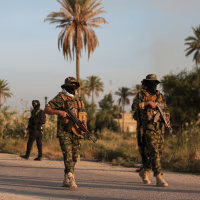
BAGHDAD, Iraq — According to three senior security officials, Iraq has struck a deal with the influential Iran‑backed militia Kataib Hezbollah after Prime Minister Ali al‑Zaidi prepared the security forces for a possible operation against the group.
The government had previously accused Kataib Hezbollah of operating a smuggling network that diverted hundreds of millions of dollars in state‑owned oil. To avoid a clash, senior Shi’ite politicians brokered an agreement that would see Iraqi forces move into the militia’s stronghold in Jurf al‑Sakhar on Friday, the officials said. In return, Kataib fighters would relocate to other locations, Lieutenant General Saad Maan, who heads Iraq’s Security Media Cell, told Reuters.
Shi’ite political sources in Iraq said the seriousness of the standoff prompted Esmail Qaani, commander of Iran’s elite Quds Force, to travel to Baghdad late on Monday to help calm the situation with Kataib Hezbollah, Tehran’s most powerful militia ally in the country.
A Kataib Hezbollah spokesperson confirmed that the group’s secretary‑general, Abu Hussein al‑Hamidawi, met with Qaani, Badr Organization chief Hadi al‑Amiri, and other senior figures in an effort to prevent an escalation. The participants later described the outcome of the talks as positive in a statement released on Thursday.
Zaidi, a political newcomer, has taken what he calls his riskiest step since assuming office six months ago by confronting the heavily armed Shi’ite militias that act as Iran’s proxies. Pro‑Iranian militias, including Kataib Hezbollah, have so far ignored repeated calls from Zaidi and U.S. President Donald Trump to lay down their weapons. Critics argue that the semi‑official status these groups enjoy in Iraq allows them to operate with near‑impunity.
Kataib Hezbollah and other militias claim they are defending Iraq’s security, yet they have repeatedly attacked U.S. forces in solidarity with Iran since the United States and Israel began a war against the Islamic Republic in February. The organization, whose full name translates to “Battalions of the Party of God,” is a shadowy network with no publicly announced leadership hierarchy and thousands of battle‑hardened fighters.
The militia forms several battalions within Iraq’s Popular Mobilization Forces (PMF), a coalition of armed groups originally created to fight the Islamic State in 2014 and later recognized as an official security force. Although the PMF is formally under the prime minister’s command, Kataib Hezbollah often operates outside that chain of command and has openly defied government directives to cease attacks on U.S. troops.
Founded after the 2003 U.S.-led invasion, Kataib Hezbollah is one of the most prominent factions of the Islamic Resistance in Iraq, an umbrella of hard‑line Shi’ite armed groups backed by Iran. Like its counterparts, the militia reports directly to Iran’s Revolutionary Guard Corps. It was previously led by dual Iraqi‑Iranian citizen Abu Mahdi al‑Muhandis until he was killed alongside Quds Force commander Qassem Soleimani in a U.S. drone strike at Baghdad’s international airport in 2020.