
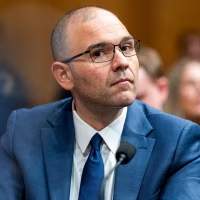
President Donald Trump’s nominee to head the agency that safeguards U.S. elections declined on Thursday to identify the winner of the 2020 presidential race or to label the Jan. 6, 2021, Capitol breach as an “attack.”
Michael LoSapio, the administration’s pick for director of the Cybersecurity and Infrastructure Security Agency (CISA), faced questioning from Senator Richard Blumenthal, a Democrat from Connecticut, during a confirmation hearing before the Senate Homeland Security Committee.
When Blumenthal asked directly who won the 2020 election, LoSapio replied, “I’m not going to answer the question about an election six years ago.” He added, “My only participation in the 2020 election was casting my vote for the president of the United States,” referring to Trump. Blumenthal said the response showed a “lack of independence and objectivity” and accused LoSapio of evading the question.
CISA has been without a Senate‑confirmed director since Jen Easterly stepped down after Trump returned to office in January 2025. The agency, created during Trump’s first term, is charged with protecting the nation’s critical infrastructure—including election systems—from cyber threats.
LoSapio, who currently serves as chief information security officer at Palantir Technologies, was also pressed about whether the Jan. 6 incident constituted an attack on the Capitol. After Blumenthal asked, “You don’t know?” LoSapio answered, “No, I don’t believe it was an attack. I wasn’t involved in politics. I know what I saw on the news.” When the senator pressed again about the nature of the riot, LoSapio reiterated that it was “not an attack.”
Trump’s own narrative of Jan. 6 has shifted over time. In the immediate aftermath, he described the events as “acts of violence and destruction” on Jan. 7, 2021. By the 2024 campaign, he was referring to the day as a “day of love.” After returning to office, he pardoned roughly 1,500 individuals and commuted the sentences of 14 people linked to the incident. The Justice Department also attempted to create an “anti‑weaponization” fund, which critics have labeled a slush fund for the president’s allies.
LoSapio is one of 13 nominees who appeared before the committee on Thursday for positions ranging from federal oversight and inspector general roles to posts with the Postal Service and the District of Columbia Superior Court.
For LoSapio to become CISA director, the committee must vote to send his nomination to the full Senate, where a simple majority would confirm him. Democrats are slated to take control of Congress in January, putting pressure on Trump’s slate of nominees.
The 2020 election outcome has already influenced CISA’s leadership. Trump dismissed the agency’s first director, Chris Krebs, weeks after the election because Krebs affirmed that the vote was secure.
LoSapio is not the first Trump‑appointed candidate to sidestep questions about the 2020 election. On Wednesday, Cody Hiland, the president’s choice for a federal appeals‑court seat, told Blumenthal, “I’m not going to answer that,” when asked who won the election. Hiland explained, “Because it’s a political issue from six years ago, and I don’t want to risk an ethical violation.” Blumenthal replied, “We know the White House told you, ‘Don’t answer that question.’”