
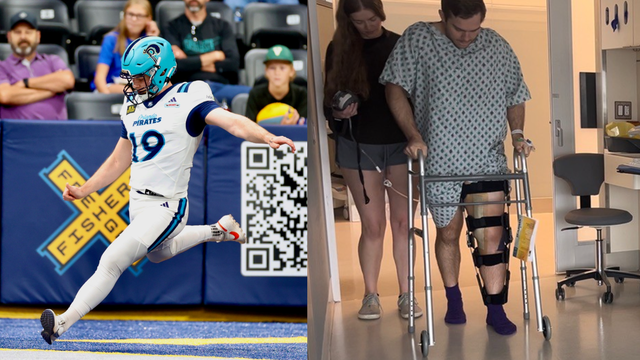
Henry Nell pushed his body to its limits throughout his athletic career. After playing professional rugby in South Africa, he moved to the United States and became a kicker in arena football, the indoor version of the sport that uses a slightly smaller field. Over the years he suited up for several teams in two different leagues, always handling the kicking duties.
In 2021 Nell began to notice stiffness in one knee. He dismissed it as a pulled muscle and, when the discomfort lingered, chalked it up to getting older. While playing for the Albany Firebirds in 2025, the team trainer suggested an X‑ray. The imaging revealed a mass behind his knee. Nell tried to convince himself it was a harmless cyst or fluid pocket, but doctors identified it as parosteal osteosarcoma, a rare, slow‑growing bone cancer that, according to specialists, had been developing for years.
The word “cancer” was not the worst part for Nell; the terror set in when a local oncologist told him amputation was the recommended treatment. “I felt like nothing could get better, like everything was collapsing. My sports career, my whole future—everything was at risk,” he recalled. “If we have to amputate, what will the next 60 or 70 years look like? How will it affect my family? Will my wife have to push me in a wheelchair? Those thoughts ran through my head. It was one of the most frightening moments of my life.”
Nell and his wife, a physical therapist, sought a second opinion in New York City. They met Dr. Nicola Fabbri, a surgical oncologist and chief of the Division of Musculoskeletal Oncology Surgery at NYU Langone Health, who specializes in limb‑preserving procedures. Dr. Fabbri outlined a plan that could eradicate the tumor while saving the leg. Because parosteal osteosarcoma grows on the bone’s surface, he proposed removing only the affected segment of bone, then reconstructing the knee with cadaveric bone grafts and metal plates.
“We talked for almost an hour, and in the last ten minutes I was in tears,” Nell said. “I couldn’t even speak; I was just crying because there was hope.” While confident he could keep the leg, Dr. Fabbri warned that the surgery might jeopardize two crucial ligaments—the anterior cruciate ligament (ACL) and the posterior cruciate ligament (PCL). Removing enough bone and tissue could damage or even require removal of those ligaments, potentially ending Nell’s ability to play.
The operation was scheduled for July 2025, three weeks after the Firebirds’ season ended. As the date approached, Nell remained optimistic. “I thought I might keep all my ligaments, that the surgeon would scoop out the cancer, and five hours later we’d start recovery,” he recalled. “But that never happened.”
The procedure lasted about 11 hours. When Nell woke, Dr. Fabbri delivered the difficult news: both the ACL and PCL had to be removed to achieve clear margins. “My world shattered again,” Nell said, adding that the development made it much harder to see a light at the end of the tunnel.
The rest of the reconstruction was successful. Two metal plates, twelve screws and a cadaveric bone graft now support his knee, a far better outcome than the amputation initially suggested. After regaining his composure, Nell asked Dr. Fabbri whether he could ever return to kicking. The surgeon could offer no guarantee. “I told him, ‘You go and tell me. This has never been done before,’” Nell recalled. “If he manages it, we can tell the next patient it’s possible.”
Six weeks post‑op, Nell was cleared to bear weight on the leg. He assembled a recovery team that included physical therapists and strength coaches, with Dr. Fabbri monitoring his progress to prevent overexertion. The medical team estimated roughly 18 months before he would regain normal daily function, and they could not predict when he might be game‑ready again.
Defying those timelines, Nell was lightly jogging and kicking within three months. He kept meticulous notes of his activities and shared them with Dr. Fabbri, who adjusted the program as needed. Less than a year after the surgery, he suited up for the Kansas Barrels in their season opener, helping the team secure a victory. “That was a huge moment for me,” he said. “I’ll cherish it forever.”
Today Nell rarely thinks about the leg that almost cost him his career. After the Barrels stint he played for the Orlando Pirates, and he and his wife recently completed a hiking trip in Peru. He plans to return to arena football for the spring 2027 season and has even begun practicing rugby with a local club “just to see if my body can still do it.”
Dr. Fabbri confirmed that Nell remains cancer‑free. Because the entire tumor was removed, the likelihood of recurrence is low, and the longer he stays disease‑free, the better his odds of never having it return.
Nell hopes his story can inspire others facing grim diagnoses. “In football we talk about leaving a legacy, about what you’ve done for the game, and I’ve thought about that for a long time,” he said. “For me, if I can help even one person who feels hopeless, that’s enough.”