
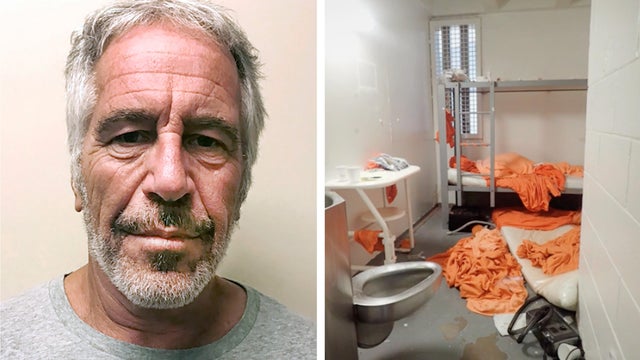
Warning: This article and accompanying video contain graphic images that may be disturbing.
A sizable portion of the American public, spanning the political spectrum, remains convinced—despite the lack of definitive proof—that Jeffrey Epstein’s death was not a suicide. A new forensic analysis, based on photographs and documents supplied by Epstein’s brother, adds a scholarly voice to that suspicion.
Dr. Michael Freeman, editor‑in‑chief of the *Journal of Forensic and Legal Medicine*, spent several months examining autopsy records that had never been released to the public. Those records were provided to him and to CBS News by Epstein’s brother. While the New York City Office of the Chief Medical Examiner officially ruled in 2019 that Epstein died by suicide, Freeman now argues that the evidence points more plausibly to homicide.
Working together with Anders Eriksson, a professor of forensic medicine at Umeå University in Sweden, and Itiel Dror, a researcher who studies bias in forensic decision‑making, Freeman presented his conclusions on Monday in London. He said he believes the “world’s most notorious sex offender was likely attacked and killed by another person” in August 2019.
“The injuries documented by the medical examiner do not fit the pattern of a suicidal hanging, and the findings that might suggest a physical struggle or assault were simply overlooked,” Freeman told CBS News after reviewing the autopsy files, photographs, and a biomedical reconstruction he created.
Freeman’s study is the second external forensic report to challenge the suicide ruling. In 2020, Epstein’s brother hired former New York City medical examiner Dr. Michael Baden, whose findings—first reported on *60 Minutes*—also raised doubts, with Baden stating that the neck injuries he observed were more consistent with murder than with suicide.
Freeman said his paper was rejected for publication because reviewers felt it was inappropriate to critique a medical examiner’s conclusions in a peer‑reviewed journal. He intends to submit the work again.
The forensic professor said the first image he examined—a view of Epstein’s right side of the face and upper torso showing ligature marks on the neck—prompted an immediate reaction. “When I saw this photograph, my first reaction was that that is a very unusual looking injury for a hanging on the neck,” he said.
Freeman has served as an expert witness in high‑profile cases and was part of the Maryland attorney general’s audit team that reviewed dozens of in‑custody deaths last year. Nonetheless, forensic pathology is not an exact science; experts can reach very different conclusions from the same evidence, especially when it comes to distinguishing injuries from hanging versus strangulation. Epstein’s case was further complicated by a series of procedural errors in the hours and days after his body was discovered in a Manhattan federal jail cell.
The New York City Office of the Chief Medical Examiner, which performed the autopsy on August 11, 2019—the day after Epstein was found dead—declined to comment and did not respond directly to Freeman’s findings when CBS News pressed for a statement. “Our office stands by its determination,” a spokesperson said.
Support for the suicide conclusion exists. In June, *The New York Times* published an investigation that relied on tens of thousands of pages of newly released documents and on handwritten notes Epstein made while in jail. That report concluded there were signs that Epstein intended to end his own life, and it noted that “almost none of the forensics experts we interviewed believed that his manner of death—suicide or homicide—could be conclusively settled based on the medical evidence alone.”
Freeman argues that the official investigation missed critical details. “The injury pattern was described as a sloped or peaked injury—a perfect description for a hanging—but that’s not what we saw in the photos,” he said. While one mark matched that description, he identified a second, lower‑positioned mark on the ligature wound that was angled differently.
“There is no mechanism that would produce a second lower mark. Even if the ligature were tied with two loops, both loops would converge at the anchor point,” Freeman explained.
When asked whether the two marks could represent Epstein attempting to hang himself twice, Freeman said research on suicidal hanging makes that scenario unlikely. “He would have had to make a false start strong enough to break his hyoid bone and thyroid cartilage, cause a deep abrasion, and then stay conscious,” he said. “That is not how suicidal hangings work. Unconsciousness occurs quickly, and the body’s weight creates the abrasion, not a sudden jump. The literature does not support such a scenario.”
According to Justice Department records, none of the guards on duty that night spoke with the medical examiner’s investigators. Some guards later falsified logs and lied about their activities the night before and the morning of Epstein’s death. Corrections officer Michael Thomas, who discovered Epstein’s body, only agreed to be interviewed after he was charged with crimes two years later. There is no evidence that the medical examiner’s office revisited its conclusion after Thomas gave his account, which described finding Epstein hanging from a bedpost.
Freeman based his reconstruction of the scene on Thomas’s later description, creating a biomechanical analysis that used three‑dimensional models matched to Epstein’s anatomy. “The biomechanical analysis was designed to map the injuries onto a model that was as close as possible to Epstein’s size and shape,” he said.
The 3‑D model allowed Freeman to test the suicide hypothesis. While some neck abrasions could be explained by a hanging, other injuries—such as a deep soft‑tissue hemorrhage in the left shoulder and a wound on the back—could not. “We have too many other injuries that are not explained by any suicidal hanging. How do you get the deep soft‑tissue hemorrhage in his left shoulder? How do you get the injury on his back?” he asked.
Freeman’s conclusions are likely to fuel the ongoing conspiracy theories surrounding Epstein’s death. “The alternative scenario is that there was a strangulation that occurred,” he said, noting that horizontal marks on the neck suggest a ligature pulled from behind.
Photographs of the cell show piles of torn orange fabric, the standard bedding at the Manhattan Correctional Center. Freeman points to an image of a knotted piece of that fabric, arguing it supports a strangulation theory. “That is a double‑knotted, looped, narrow ligature that was found in the cell, dropped near the desk. If we apply that knot as pressure, it can produce the irregular abrasion at the back of the neck, giving us a fairly good explanation for all the injuries,” he said.
He also identified what he believes are signs of a struggle, including blunt‑force trauma to the face and left shoulder, and possible fingernail marks above the ligature. “Putting it all together, it is most consistent with a homicidal strangulation from behind using a narrow knotted fabric ligature,” Freeman concluded.
The fabric Freeman cites was not collected for the medical examiner’s analysis. “The front view of the ligature pattern looks ragged and segmented, not smooth. That would not be consistent with the noose taken from the room,” he noted.
Epstein’s death made global headlines and prompted promises from senior Justice Department officials that it would be one of the most thoroughly examined inmate deaths in history. Instead, a cascade of failures marred the investigation.
Problems began almost immediately on August 10, 2019, when Thomas reported finding Epstein’s body, cold to the touch, around 6:30 a.m. “The fact that the body was cold indicates he had been dead for at least a few hours,” Freeman said.
The body was removed from the cell within minutes, preventing investigators from photographing the scene accurately. The cell was never sealed for forensic examination, and much of the physical evidence was not preserved, a 2025 CBS News investigation later found. Adding to the confusion, most of the closed‑circuit cameras in Epstein’s wing were out of service. Justice Department documents reveal that investigators who reviewed footage from the nearest working camera—showing a common area that connected multiple cell tiers—failed to follow up on an unexplained orange blur that appeared to move up a staircase toward Epstein’s block on the night of his death.
It took two years for federal investigators to interview Thomas, who had been charged with falsifying prison records, and another year before they spoke with the medical examiner who performed the autopsy. Freeman says the examiner may have misread key details, noting that there were no broken fingernails or defensive wounds on the hands, and that an abrasion on Epstein’s arm, which the examiner attributed to convulsing during a hanging, overlooked a deep intramuscular hemorrhage in the left shoulder that Freeman believes resulted from blunt‑force trauma.
“To me, the mystery isn’t how he died; it’s who killed him,” Freeman said. “Who did it? Exactly how they did it? All the other things. Why the cameras were off? All a mystery, yes. Was this a suicide? Not a mystery.”