
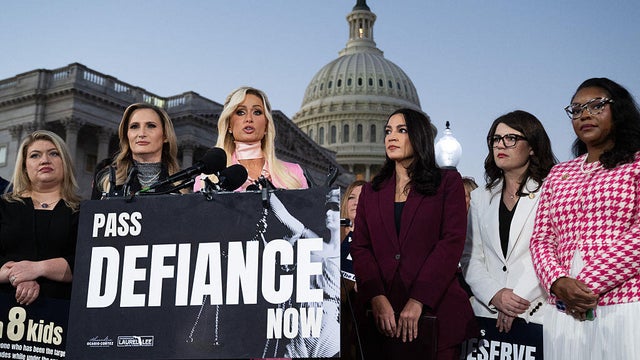
Washington – On Tuesday, Paris Hilton went back to Capitol Hill to renew her appeal to members of the House of Representatives to move forward a bipartisan proposal that would let victims of sexually explicit deep‑fake images sue the people who create or share those AI‑generated pictures without permission.
Hilton, whose own private video was leaked by an ex‑boyfriend when she was 19 and who has said that more than 100,000 pornographic deepfakes of her circulate online, described the personal toll of having intimate material distributed without consent.
“Ten months ago, I stood here at the Capitol and told the world what it feels like to have your body exposed without your consent, and I asked Congress to do something about it,” she said outside the Capitol. “The laws aren't protecting us. And if this can happen to someone with my resources and my platform, imagine how powerless a young girl might feel facing this completely alone.”
She was accompanied at a press briefing by Democratic Representative Alexandria Ocasio‑Cortez of New York and Republican Representative Laurel Lee of Florida, both of whom have co‑sponsored the legislation, known as the DEFIANCE Act.
The bill would permit victims to recover any profits generated from the unauthorized images and would set a ten‑year limitation period that starts when the victim either discovers the violation or turns 18, whichever occurs later.
“Once these images are shared, the damage can be devastating,” Lee said. “Victims can face harassment, threats and lasting harm. Their relationships, educational opportunities and even careers can be affected by fake images that were created entirely without their consent.”
The Senate approved the measure by unanimous consent in January. A week later, Hilton visited Capitol Hill urging House members to follow suit, but the proposal has since stalled in the lower chamber.
House Speaker Mike Johnson’s office did not reply to a request for comment on the delay.
“For ten months, this critical legislation has sat untouched in the House, just waiting to be put on the floor,” Ocasio‑Cortez said. “This bill has now passed unanimously in the Senate, not once but twice, in 2024 as well as earlier this year. And we have to ask, why hasn't it been brought to the House floor for a vote?”
Ocasio‑Cortez added that advocates of the DEFIANCE Act have been in talks with the White House and feel “very optimistic” about President Trump and the administration’s willingness to consider the bill.
The proposal builds on the Take It Down Act, a law championed by former First Lady Melania Trump that makes it a federal crime to post either real or deep‑fake intimate images of a person without that person’s consent. The statute also obligates social‑media platforms and other websites to remove such content within 48 hours after a victim’s request.
In preparing for her Capitol meetings, Hilton said her staff compiled data on how many members of Congress have sexual deepfakes circulating online, describing the results as “shocking but hardly surprising.”
“Of the 156 women serving in the 119th Congress, 83 have sexual deepfakes online right now,” she noted, adding that 50 million people have been victimized by explicit deepfakes.
Hilton concluded by addressing Speaker Johnson, Majority Leader Steve Scalise and House Judiciary Committee Chairman Jim Jordan—who is set to become minority leader next year—urging them to permit a vote.
“Speaker Johnson, Leader Scalise, Chairman Jordan: I am speaking directly to you. Will you allow this to continue to happen to your colleagues? How about the women in your district? How about your daughters, your wives or your sisters?” she asked. “You have the power to move this legislation forward.”