
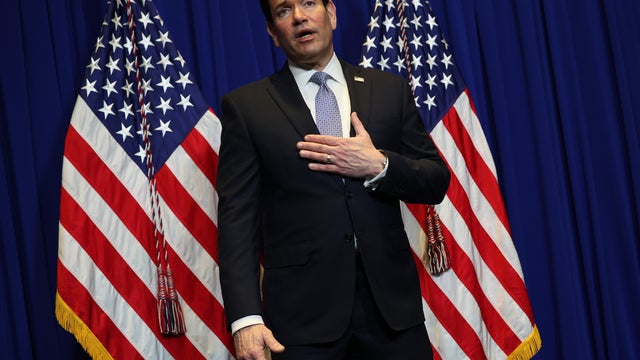
Secretary of State Marco Rubio told reporters on Wednesday morning that there is “zero evidence” linking the recent technical failures that have affected U.S. air travel, banking and other sectors. Speaking at a news conference in the Philippines while traveling with President Donald Trump ahead of a three‑way summit with Russian President Vladimir Putin and Chinese President Xi Jinping, Rubio said the Microsoft outage, the FAA disruption and the banking glitches are unrelated.
“The Microsoft problem has nothing to do with what happened at the FAA, and the FAA issue is separate from the banking incidents we saw a few days ago,” Rubio said. “From a technical perspective, each of these events is distinct and has its own cause.”
He acknowledged that the string of problems has left many people uneasy, and he wanted to assure the public that the United States is not facing a coordinated attack. “We have no evidence, nor any reason to suspect, that any of these isolated incidents involve malicious actors—whether hackers, criminals, foreign governments or any other hostile entity,” he added.
Rubio emphasized that the administration is constantly monitoring for potential threats, but reiterated that the recent outages appear to be independent technical failures. “Each one is different in its origin,” he said.
The timeline of the incidents began on Thursday when Microsoft reported a global outage that knocked out services such as Outlook and Teams for users, businesses and government agencies worldwide. The company attributed the disruption to a technical fault rather than to any cyber‑attack.
The following day, the Federal Aviation Administration ordered a nationwide ground stop on all departing flights in the United States, causing significant chaos in the aviation sector. Federal officials later identified a contractor’s maintenance update as the trigger for Friday’s systemwide failure, though some questions about the deeper cause remain unanswered.
In the days that followed, major banks—including JPMorgan Chase, Bank of America and U.S. Bank—experienced temporary service interruptions, and Apple reported problems with its online services. Additionally, sources familiar with the matter told CBS News that the National Security Agency’s internal network for classified information went offline on Tuesday.
Democratic Senator Mark Warner, who serves as vice chair of the Senate Intelligence Committee, also said on Tuesday that there is no sign these events resulted from an attack. He warned, however, that the rapid advancement of artificial intelligence is putting pressure on companies and government agencies to patch vulnerabilities at a speed that many systems were not designed to handle. In a post on X, Warner wrote, “AI is making it possible to identify vulnerabilities across enormous numbers of systems at unprecedented speed, creating enormous pressure on companies and government agencies to patch those vulnerabilities immediately, often all at once, putting tremendous strain on systems that weren’t built to handle that pace of change. It feels like every day brings another reminder that AI is moving faster than our ability to manage its consequences. This is exactly why I’ve been pushing for commonsense guardrails on AI and stronger cybersecurity protections.”
When pressed about whether artificial intelligence might have played a role in the recent glitches, Rubio declined to speculate, noting that each incident involves different companies and circumstances.