
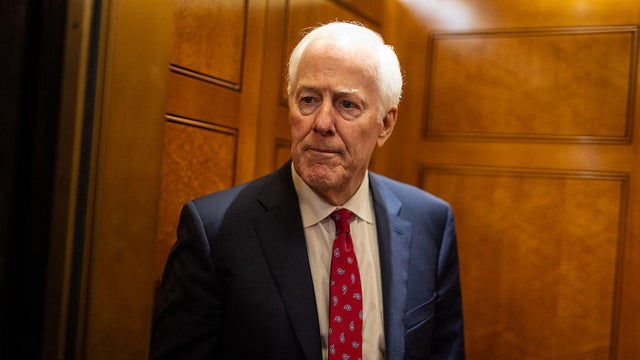
Washington — Texas Republican Senator John Cornyn has halted President Donald Trump’s effort to place T. Elliot Gaiser, a senior Justice Department official, on the federal district bench in the Dallas region.
Cornyn told CBS News on Capitol Hill that he refused to return the customary “blue slip” for Gaiser, a move that effectively stops the nomination from moving forward in the Senate Judiciary Committee.
“I don’t see a path for his confirmation,” the senator said. When pressed about his objections to Gaiser’s candidacy for the U.S. District Court for the Northern District of Texas, Cornyn replied, “He isn’t from Texas, he lacks trial experience, and the White House tried to sidestep the Senate, preventing us from conducting the due‑diligence required for a lifetime appointment.”
Gaiser had been slated to appear before the Judiciary Committee for a hearing on Wednesday, but he was not among the seven judicial candidates who ultimately testified.
During a discussion at The Atlantic Summit on Tuesday, Cornyn reiterated that “he’s not from Texas,” calling it “a fundamental issue.” He added, “The Constitution calls for advice and consent, yet there was no consultation, no attempt to work with the Senate. I’ve suggested an alternative, but we’ll see if they accept it. The Senate should not be a rubber stamp, and we’ve been too often.”
The blue‑slip tradition is meant to foster dialogue between the White House and the two senators from a nominee’s home state—in this case, Cornyn and fellow Republican Ted Cruz. After a president selects a candidate, the home‑state senators receive a blue‑colored form indicating approval or objection. Withholding the slip, as Cornyn has done, signals disapproval and blocks the nominee from receiving a committee hearing unless both home‑state senators return positive slips.
Trump has urged Judiciary Committee Chairman Chuck Grassley, a Republican from Iowa, to eliminate the blue‑slip practice, but Grassley has kept the custom in place for district‑court and U.S. attorney nominations.
As the lame‑duck session begins after the November 3 midterms, the committee is racing to confirm the remaining Trump nominees before the new Congress convenes in January and Senate control shifts. Democrats are projected to hold 56 seats, making it unlikely that many of the president’s appellate and district‑court picks will be confirmed.
Trump announced last week that he would nominate Gaiser to the Northern District of Texas, and the formal nomination was transmitted to the Senate on Monday.
Cornyn noted that Gaiser does not reside in Texas; his only connection to the state appears to be a one‑year clerkship in Houston for a Fifth Circuit judge. Originally from Ohio, where he served as solicitor general, Gaiser moved to Washington after joining the Trump administration last year as head of the Justice Department’s Office of Legal Counsel.
In a questionnaire submitted to the Judiciary Committee, Gaiser said he was first approached about the vacancy by Cruz’s staff on November 4, a day after Democrats secured sweeping wins in the midterms. He reported discussing a possible nomination with Cornyn’s office on November 6 and learning from the White House Counsel’s Office that same day that the president was considering him. The questionnaire is dated November 7, while Trump publicly announced the nomination on November 10.
As associate attorney general for the Office of Legal Counsel, Gaiser has faced criticism for several of his legal memoranda, which guide the president and federal agencies and are treated as binding within the executive branch.
Among the contentious opinions he authored is one that justified U.S. military strikes on vessels suspected of drug smuggling in the eastern Pacific and Caribbean. In an April memo, he argued that the Presidential Records Act—requiring the president to preserve certain documents and turn them over to the National Archives after leaving office—is unconstitutional. An August opinion concluded that the president’s outside advisers, who are not federal employees, are shielded from future congressional and legal investigations, finding that communications with private outsiders generally fall under executive privilege.