
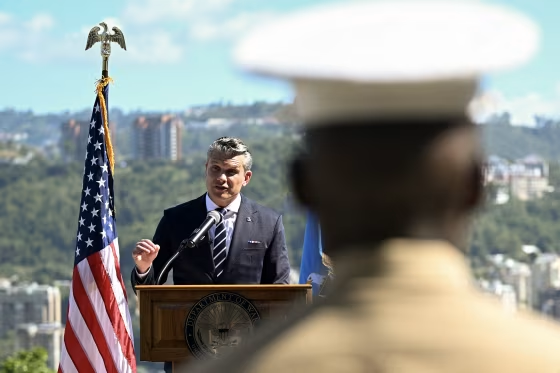
CARACAS, Venezuela — U.S. Secretary of Defense Pete Hegseth arrived in Caracas on Wednesday to meet with the country’s interim leadership, a move that highlights the Trump administration’s push to expand its foothold in Venezuela after U.S. forces removed President Nicolás Maduro in January.
Hegseth is the most recent cabinet member to travel to the South American nation, following trips earlier this year by the secretaries of the Interior and Energy, who have been concentrating on accessing Venezuela’s oil fields and strategic minerals. In August, President Donald Trump credited Hegseth with helping negotiate a broad agreement that would give the United States control over portions of Venezuelan oil assets.
State television in Venezuela aired footage of Hegseth inside the presidential palace, standing beside acting President Delcy Rodríguez. The Pentagon did not announce the visit in advance. It comes months after a covert nighttime operation by U.S. forces in the capital that captured Maduro and transferred him to New York to face drug‑trafficking charges, accusations the former leader continues to deny in U.S. court.
During a televised segment with Hegseth, Rodríguez said the two countries are working on cooperation deals that would enable the United States to provide training for Venezuela’s armed forces. “Expanding the training of our Bolivarian National Armed Force, improving its operational equipment, and opening the door to new technologies is highly advantageous for our military personnel,” she said, adding that such training would help both nations confront shared threats.
Hegseth expressed optimism about deepening the bilateral defense relationship and collaborating on anti‑drug‑smuggling efforts. “We discussed the long‑standing ties between our nations, and in many respects this feels like a renewal of our defense partnership and an opportunity for our two great militaries to work together,” he said.
General Francis Donovan, who heads U.S. Southern Command and oversees military operations in Latin America, has also met with the interim Venezuelan authorities at least twice this year.
Since President Trump returned to the White House, the United States has increased its focus on the region, pledging to give greater attention to the Western Hemisphere and to combat Latin American drug cartels. To curb the flow of narcotics into the United States and address the surge in overdose deaths, U.S. forces have been targeting vessels they allege are smuggling drugs across the Caribbean and the eastern Pacific. The administration reports that more than 240 people have been killed since it began its campaign against what it calls “narcoterrorists” in September 2025, though officials have released little public evidence to substantiate the drug‑smuggling claims.
Hegseth’s trip occurs amid political uncertainty in Venezuela over who will lead the country in the coming months. Rodríguez, a close ally of Maduro, assumed the interim presidency after his capture. Although her court‑approved term officially ended in July, she continues to act as head of state.
Opposition figure María Corina Machado recently returned from exile after a series of seven thwarted attempts to reenter the country, according to opposition activists. Secretary of State Marco Rubio described her “safe” return as the result of “reconciliation talks” backed by the United States, calling it the best chance in three decades for Venezuela to hold free, fair elections and establish a lasting democracy.
The absence of a scheduled presidential election has left many Venezuelans divided in their view of the Trump administration. While some are relieved that Maduro is no longer in power, others feel that Washington’s emphasis on reviving the oil sector, rather than advancing democratic reforms, will not bring meaningful change.
According to a report released this month, the Trump administration says it has returned more than $12 billion—about 99 % of the revenue generated from Venezuelan oil sales—back to the country under the terms of the energy agreement reached with Rodríguez’s interim government.