
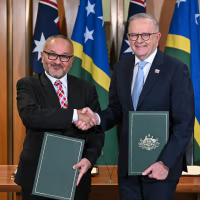
The Solomon Islands have turned down a secretive four‑year‑old defence agreement with China that had sparked concerns about a possible Chinese naval presence in the South Pacific. At the same time, the nation signed a new security treaty with Australia, in which both sides pledged that no foreign military or security base would ever be established on Solomon Islands territory.
The archipelago sits along the sea lane that links the United States and Australia – the same route General Douglas MacArthur used to direct the Pacific campaign in World War II. Battles between U.S. forces and Japan were fought on the islands, and today, with a population of under 900,000, the Solomons remain a strategically valuable piece in the broader contest between Washington and Beijing.
Prime Minister Matthew Wale and Australian Prime Minister Anthony Albanese signed the bilateral pact after reports emerged that the Solomon Islands intend to let its defence treaty with China lapse next year. The agreement designates Australia as the Solomon Islands’ “primary security partner” and explicitly bars the construction of any foreign military or security installation on the islands, which lie about 2,000 km (1,200 miles) northeast of Australia, the two leaders said in a joint statement.
The new accord follows a series of similar security arrangements that Australia has forged with Pacific neighbours since Beijing signed a 2022 treaty with the Solomon Islands’ former government – a deal that raised alarms that China might establish a naval base in the region. Since the Albanese administration took office in late 2022, Australia, a close ally of the United States, has been working to curb Chinese influence by signing security pacts with countries such as Fiji, Tuvalu and Vanuatu. In 2024, Australia also concluded a security‑linked agreement with Papua New Guinea that includes a A$600 million (US$396 million) ten‑year package and even a place for a Papua New Guinean rugby league team in the Australian competition.
Wale declined to confirm media reports that his government had informed Beijing that the Chinese security arrangement – which has seen Chinese police trainers operating in the capital, Honiara – would not be renewed when it expires in early 2027. “There is a confidentiality clause in the treaty with China, so I can’t discuss the details. We are still in talks with them,” he told reporters at a press conference with Albanese at Australia’s Parliament House. “For a long time the Solomon Islands have been a source of uncertainty in the region. Those days are over. We do not want to return to that situation,” he added.
In Beijing, Foreign Ministry spokesperson Guo Jiakun avoided giving a direct answer when asked whether the Solomon Islands had indicated an intention to end the Chinese security pact. “China always adheres to the principles of mutual respect and equality in its relations with the Solomon Islands,” Guo said on Tuesday. “Our cooperation with Pacific island nations, including the Solomon Islands, is not driven by geopolitical rivalry or bloc confrontation.”
Albanese said the new treaty lifts bilateral ties to an unprecedented level of closeness. Beyond defence, the agreement also commits Australia to support projects in infrastructure, education, renewable energy and sport in the Solomon Islands.
Oliver Nobetau, director of the Pacific Islands program at the Lowy Institute in Sydney, called the treaty “significant” and well‑aligned with the Solomon Islands’ own priorities. “It shows that Australia is listening to what its Pacific partners want,” he told the Australian Broadcasting Corporation.