
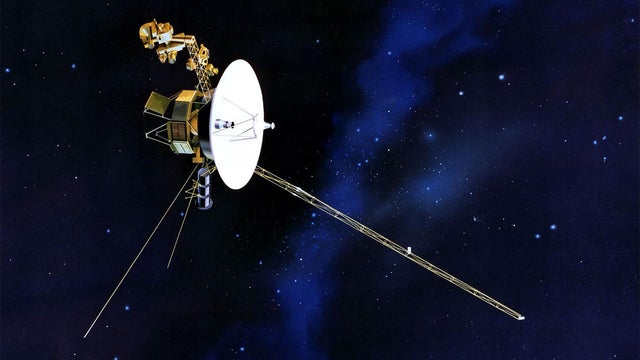
NASA’s Voyager 1 spacecraft, launched in 1977 to capture the first close‑up images of Jupiter, Saturn and their moons, passed the one‑light‑day mark from Earth early Wednesday. At more than 16 billion miles away, it is now the most distant human‑made object ever to leave our planet.
Its twin, Voyager 2, took a different path, visiting Uranus and Neptune after the “Grand Tour” of the outer planets, and then followed Voyager 1 out of the solar system, entering interstellar space in 2018—six years after its sister craft.
Both probes continue to transmit data on magnetic fields, charged particles and plasma waves in the space between the stars, even as their power supplies dwindle and their signals grow ever fainter.
At 5:16 a.m. EST on Wednesday, Voyager 1, cruising at roughly 38,000 mph, was slated to cross the one‑light‑day threshold. Radio waves travel at about 186,000 miles per second, so a signal from the probe now takes a full 24 hours to reach the team at NASA’s Jet Propulsion Laboratory. Consequently, the 13‑person operations crew will not hear the first post‑milestone transmission until Thursday.
The accomplishment is widely regarded as unparalleled; no other space agency has launched a mission that rivals Voyager, a venture many compare to the Apollo moon landings in terms of its significance for American spaceflight.
“It’s difficult to describe, difficult to put into words,” said Voyager Interstellar Mission Manager Kareem Badaruddin, one of only three full‑time staff members who keep the aging probes healthy and their antennas pointed at Earth. “I feel like this mission is one of the great things that people have ever done, that humans have ever done. All of us, every person, whether they’ve worked on this mission or not, can take some pride in it and can feel like this is a part of what our civilization has accomplished.”
The longevity of the Voyagers is uncertain because the plutonium‑238 in their radioisotope thermoelectric generators (RTGs) is slowly decaying. Engineers hope, with careful management, to keep the instruments sending data for several more years before the power finally runs out.
When launched, Voyager 1’s generators produced about 470 watts; today they deliver just over 210 watts—enough to power two of its ten scientific instruments and maintain the spacecraft’s orientation for communications. Voyager 2’s RTGs are slightly stronger, supplying a little more than 230 watts, which supports three instruments.
Even after the electricity is exhausted, both spacecraft are expected to remain structurally intact for a billion years or more, outlasting human civilization by a wide margin.
Each probe carries a “message in a bottle” – a gold‑plated phonograph record that encodes images and sounds from Earth. The records feature greetings in 55 languages, 115 photographs of people, wildlife and technology, natural sounds, and a curated selection of music ranging from J.S. Bach to Navajo chants and Chuck Berry’s “Johnny B. Goode.”
Carl Sagan, who oversaw the golden‑record project, explained in the 1980 *Cosmos* series: “If Voyager should, sometime in its distant future, encounter beings from some other civilization in space, it bears a message, a phonograph record … with instructions for use. And on this record are a sampling of pictures, sounds, greetings and an hour and a half of exquisite music, the Earth’s greatest hits, a gift across the cosmic ocean from one island of civilization to another.”
Beyond the solar system, the data stream from Voyager 1’s 12‑foot dish is transmitted with less power than a typical 40‑watt refrigerator bulb. By the time the signal arrives on Earth a day later, its strength has dwindled to a fraction of a trillionth of a watt—far less than what powers a wristwatch. To detect such a whisper, NASA relies on the 230‑foot dishes of its Deep Space Network.
Commands sent from JPL now take a full day to reach the probe, and another 24 hours is required to learn whether the spacecraft received and acted on them. As a result, troubleshooting is a painstakingly slow process.
“If you want to say ‘hello’ to Voyager, you send your message and then you go home and you wait two days before you finally get a response,” explained Voyager project manager Suzanne Dodd in an online post.
Both Voyagers draw electricity from RTGs that convert the heat of decaying plutonium‑238 into electric power. As the fuel diminishes, the team must balance power usage with the heat needed to keep fuel lines from freezing, ensuring that thrusters can fire when necessary to keep the antennas aimed at Earth.
Badaruddin said the small flight‑control team feels a heavy responsibility for the probes’ survival.
“If ever you get that sense that ‘oh, I made a mistake, I’m the one who caused a problem for the spacecraft,’ that’s crushing,” he said. “Every one of the team members feels they’re committed to doing everything in our power to do our best for these spacecraft. We’re doing everything we can to keep them going for as long as we can.”
Only three of the 13 people who work on Voyager are full‑time JPL employees; two are retirees who helped at launch and returned for the interstellar phase, while the remaining members split their time between Voyager and other projects.
“I’ve been at JPL for 32 years, and everybody loves their spacecraft, and everybody feels like it’s a family member and gives everything they’ve got for it,” Badaruddin noted. “And Voyager is no different in that regard. And these two retirees have come back and given a tremendous amount of effort and time.”
The Voyager program was green‑lighted in the early 1970s when the outer planets aligned in a configuration that allowed a “Grand Tour”—gravity‑assist flybys that could hop from one planet to the next, shaving years off the travel time. Budget constraints limited the original plan to flybys of Jupiter and Saturn. Voyager 2 launched first, on 20 August 1977, followed by Voyager 1 on 5 September.
Voyager 1’s faster trajectory took it to Jupiter in 1979, where it sent back iconic images of the Great Red Spot, the turbulent atmosphere, and detailed views of moons such as Europa—believed to hide a global ocean beneath an icy crust—and Io, the most volcanically active world known. The probe then proceeded to Saturn, delivering unprecedented pictures of the planet’s rings, shepherd moons, atmosphere and the cloud‑shrouded moon Titan.
After Voyager 1 completed its primary objectives, NASA approved a Saturn flyby for Voyager 2, which then used gravitational assists to visit Uranus in 1986 and Neptune in 1989.
On 14 February 1990—Valentine’s Day—Voyager 1’s cameras captured a family portrait of the six largest planets (Venus, Earth, Jupiter, Saturn, Uranus and Neptune) from a distance of 3.7 billion miles. Earth appeared as a tiny blue dot in a pinkish glow of reflected sunlight.
“Consider again that dot. That’s here. That’s home. That’s us,” Sagan said of the image. “On it everyone you love, everyone you know, everyone you ever heard of, every human being who ever was, lived out their lives … on a mote of dust suspended in a sunbeam.” He added that the picture underscores humanity’s responsibility to treat one another kindly and to cherish our “pale blue dot,” the only home we have ever known. Voyager 1’s cameras have been turned off since then.
In 2012, Voyager 1 crossed the heliopause—the outer boundary where the solar wind gives way to interstellar space—entering what planetary scientist Carolyn Porco, a member of the Voyager imaging team, describes as “the realm of deep time.”
Porco estimates that in roughly 18 000 years Voyager 1 will be one light‑year (about 5.8 trillion miles) from Earth, still well within the Sun’s dominant gravitational sphere. In a million years it will have traveled about 56 light‑years, remaining within the Sun’s local interstellar neighborhood—a low‑density region of diffuse hydrogen, helium and scattered stars. After 100 million years, the probe will be about 2 000 light‑years away, moving through molecular clouds, star‑forming regions, nebulae and supernova remnants. In a billion years, Voyager 1 will have drifted roughly 20 000 light‑years from the Sun, having completed four circuits around the Galactic center. By then the Sun’s increasing brightness will have rendered Earth uninhabitable, ending photosynthesis and complex life, and both the planet and its creators will be long gone.
The long‑range outlook invites reflection on the fleeting nature of existence and the value of life—a sentiment that many consider Voyager’s most profound legacy.